If you’re planning a trip through Guatemala, chances are you’ve already heard of Tikal.
Hidden deep within the rainforest of northern Guatemala, Tikal National Park is home to one of the largest and most important ancient Mayan cities ever discovered. Towering temples rise above the jungle canopy, wildlife moves through the forest around you, and every year thousands of travellers make the journey from Flores to experience what many consider the best Mayan ruins in Guatemala.
But after visiting myself, I don’t think the ruins are what make Tikal special.
The first thing that struck me wasn’t the temples.
It was the sound.
As we walked through the jungle, deep roars echoed through the trees around us. For a moment it genuinely sounded like dinosaurs were hiding somewhere in the rainforest canopy. The noise came from howler monkeys, whose distinctive calls were famously used as inspiration for dinosaur sounds in films such as Jurassic Park.
It set the tone perfectly for the day ahead.
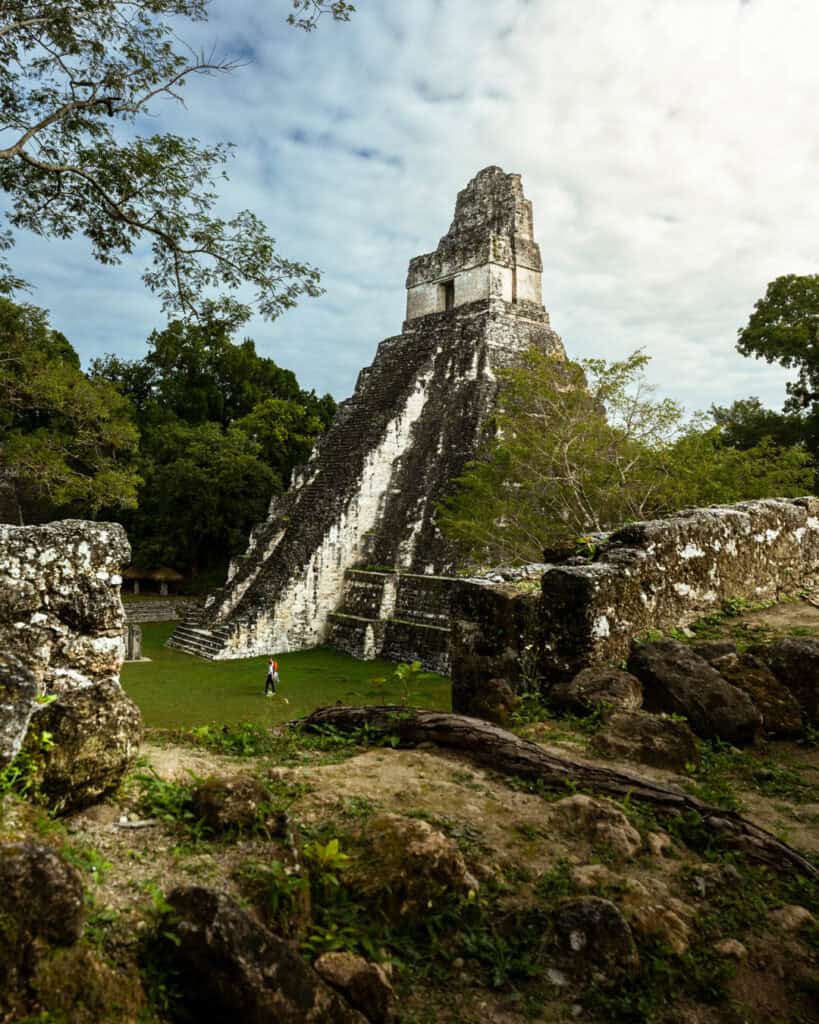
Visiting Tikal feels less like walking around an archaeological site and more like exploring a lost city that the jungle is slowly reclaiming. Temples emerge from the trees without warning. Wildlife moves through the forest around you. Some structures remain partially buried beneath vegetation, while others rise above the canopy, offering views across an endless sea of rainforest.
Having visited several archaeological sites across Central America, including Chichén Itzá in Mexico, Tikal was easily my favourite.
Part of that comes down to scale. The site is enormous, and by the end of the day I’d walked more than 20,000 steps exploring temples, plazas, and jungle trails.
But the biggest difference is the atmosphere.
Unlike many famous ruins, Tikal still feels raw. There are temples covered in vines. There are structures hidden beneath the jungle that archaeologists haven’t fully excavated. There are no roads cutting through the middle of the site and no feeling that you’re walking around a carefully curated outdoor museum.
Instead, it feels like you’ve stumbled across an ancient city hidden within the rainforest.
I wouldn’t fly across the world solely to visit Tikal in the same way people might for Machu Picchu. But if you’re travelling through Guatemala or neighbouring Belize, I genuinely think it’s unmissable.
If you’re only going to visit one set of ruins in Central America, I’d make it Tikal.
Tikal Guatemala: Quick Facts
- Location: Tikal National Park, Petén, Northern Guatemala
- Nearest town: Flores
- Distance from Flores: Approximately 60 km
- Time needed: One full day
- Best viewpoint: Temple IV
- Difficulty: Easy to moderate
- Can you climb the temples? Some yes, some no
- Worth visiting? Absolutely
Quick Guide To This Article
- Is Tikal worth visiting?
- How to visit Tikal from Flores
- Tikal entrance fees and tour costs
- What it’s actually like exploring Tikal
- The best temples in Tikal
- Wildlife in Tikal National Park
- Sunrise vs daytime tours
- Tikal vs Chichén Itzá
- Whether you need a guide
Is Tikal Worth Visiting?
Yes.
In fact, if you’re travelling through Guatemala or Belize, I’d go a step further and say it’s one of the places you shouldn’t skip.
That’s not because it’s the most famous ruin in the world. It isn’t.
It’s because Tikal combines several experiences into one.
You’re not simply visiting an archaeological site. You’re exploring a rainforest, spotting wildlife, climbing ancient pyramids, learning about Mayan history, and looking out across one of the largest areas of protected jungle in Central America.
If you’re currently planning your route through the country, I’d have no hesitation including Tikal in a wider Guatemala itinerary.
What surprised me most was how immersive it feels.
Many famous ruins feel disconnected from their surroundings. They’re impressive, but they can also feel heavily managed and heavily visited.
Tikal feels different.
As you move through the site, the jungle is constantly present. The sounds of birds and monkeys echo through the trees, narrow paths connect huge plazas, and every so often another enormous temple appears through the vegetation.
Even now, there are still parts of the ancient city hidden beneath the forest.
Some of the hills you pass aren’t hills at all. They’re structures that archaeologists know are there but haven’t fully excavated.
That sense of discovery is what makes Tikal stand out.
If you’re interested in history, you’ll love it.
If you’re interested in wildlife, you’ll love it.
And even if you’re somebody who normally finds historical sites a little boring, Tikal has a way of making the history feel real.
It’s one of the few places I’ve visited where I found myself genuinely wanting to learn more after leaving.
How To Visit Tikal From Flores
The vast majority of travellers visit Tikal from Flores, the colourful island town that serves as the main gateway to the ruins.
If you’re staying in Flores, the easiest option is to book a tour that includes transport.
That’s exactly what I did.
My tour departed Flores at around 8am before heading north towards the park. Before entering the ruins, we stopped at a small café outside the park for a traditional Guatemalan breakfast, which was included as part of the tour.
After breakfast, we entered the park and spent the majority of the day exploring the site with a guide.
We eventually returned to Flores in the late afternoon after what had been a surprisingly full day.
Although it’s possible to visit independently, I think organised tours make the most sense for most travellers. Transport is straightforward, guides provide valuable context, and you don’t need to worry about navigating such a large archaeological site on your own.
If you’re staying in Flores, I’d recommend allowing at least three nights in town. That gives you enough time to visit Tikal while still enjoying the island itself. I cover that in much more detail in my Flores travel guide.
If you’re planning to move around the country independently, it’s also worth reading my guide to getting around Guatemala before you travel.
Tikal Entrance Fees & Tour Costs
One thing that surprised me about Tikal was how affordable it was compared to many of the world’s other famous archaeological sites.
When I visited, I paid 138 quetzals for a guided tour including transport from Flores.
On top of that, foreign visitors also need to pay the Tikal entrance fee, which was 150 quetzals.
That brought the total cost of my visit to around 288 quetzals.
Sunrise and sunset tours are typically more expensive due to the additional logistics and park access requirements, but many travellers consider the extra cost worthwhile for the atmosphere.
Even so, considering the scale of the site and the fact you’ll spend most of an entire day there, I thought Tikal offered excellent value for money.
If you’re budgeting for a trip through the country, my full Guatemala travel cost breakdown will give you a better idea of what to expect.
What It’s Like Visiting Tikal
The best way I can describe Tikal is that it doesn’t feel like a tourist attraction.
It feels like an adventure.
What surprised me was how long Tikal takes to reveal itself.
Unlike many famous attractions where you’re standing in front of the main sight within minutes of arriving, Tikal makes you work for it.
After entering the park, you’re walking through dense rainforest with very little indication of what’s ahead.
The sounds of the jungle surround you.
Occasionally you’ll pass smaller structures hidden amongst the trees.
Then gradually the signs of civilisation begin to appear.
Before eventually the jungle opens completely and you’re standing in the Central Plaza surrounded by temples that have stood here for more than a thousand years.
That first moment is impressive.
Not because it’s the biggest structure you’ll see all day.
But because it’s the moment Tikal transforms from an idea into a real place.
The site is enormous, and you’ll spend much of the day moving between temples, plazas, and jungle trails.
By the time I returned to Flores, I’d covered more than 20,000 steps.
Fortunately, the terrain itself isn’t particularly difficult. Most of the site is relatively flat, and you don’t need to climb every structure.
The challenge comes from the sheer size of the place combined with the heat and humidity.
It’s a tiring day.
But it’s never a difficult one.
The Sounds of Tikal
The first thing you’ll notice at Tikal isn’t the temples.
It’s the noise.
Throughout the day you’ll hear deep, guttural roars echoing through the rainforest canopy. The sound is genuinely unsettling the first time you hear it. It doesn’t sound like a monkey. It sounds like something much larger lurking somewhere in the jungle.
The source is the park’s population of howler monkeys.
Standing in the middle of an ancient Mayan city while dinosaur-like roars echo through the jungle is about as immersive as historical sightseeing gets.
What’s particularly interesting is that howler monkey calls were used as inspiration for dinosaur sounds in several films, including Jurassic Park. Once you know that fact, it’s almost impossible not to make the connection when you hear them for yourself.
Even when you can’t see wildlife, you’re constantly aware of it.
The jungle never feels empty.
You hear movement in the trees. Calls echo through the canopy. Birds appear and disappear between branches.
It creates a feeling that the ruins and rainforest are still sharing the same space rather than existing separately.
Several travellers I met who completed the sunrise tour told me this aspect of the experience was even more intense before dawn. Walking through the darkness while hearing howler monkeys somewhere beyond the trees apparently makes the jungle feel even more alive.
Even during the daytime tour, though, the sounds of the forest are a huge part of what makes Tikal memorable.
The Best Temples In Tikal
One thing that surprised me was how varied the different structures feel.
Many visitors arrive expecting to see one famous pyramid and then spend the rest of the day looking at similar ruins.
In reality, Tikal contains a huge variety of temples, plazas, ceremonial structures, and viewpoints.
Some impress because of their size.
Others because of their history.
And a few stand out because they completely change the way you understand the scale of the ancient city.
Central Plaza
The Central Plaza is where many visitors get their first real sense of the scale of Tikal.
Surrounded by towering temples and important ceremonial buildings, it’s one of the most iconic areas of the site and often the first place where people stop and think, “wow.”
This is where Tikal begins to feel like a city rather than a collection of ruins.
Standing in the plaza, it’s easy to imagine the thousands of people who once lived, traded, worshipped, and governed here.
What had previously felt like an archaeological site suddenly feels like a real place.
Temple IV
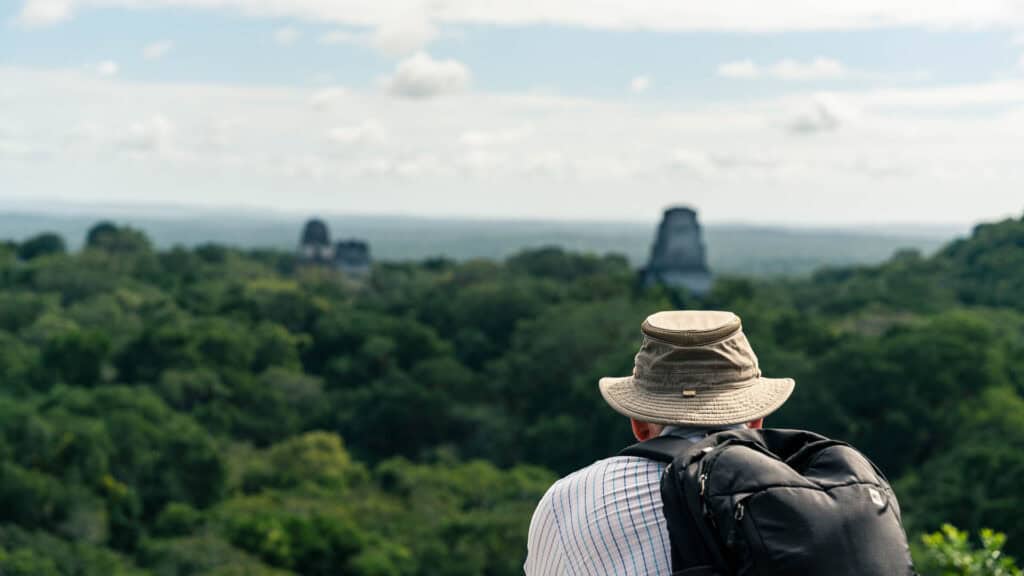
Temple IV is the tallest structure in Tikal and offers the most famous view in the park.
From the viewing platform near the top, you can look out across an endless carpet of rainforest stretching towards the horizon.
Emerging through the canopy are the tops of other temples, creating one of the most recognisable views in Guatemala.
Although we only spent a few minutes at the top taking photos and enjoying the scenery, it’s easy to understand why this has become the signature image of Tikal.
The view perfectly captures what makes the site unique.
You’re not looking across a city.
You’re looking across a jungle that happens to contain a city.
The Lost World Complex
Perhaps surprisingly, the structure that impressed me most wasn’t Temple IV.
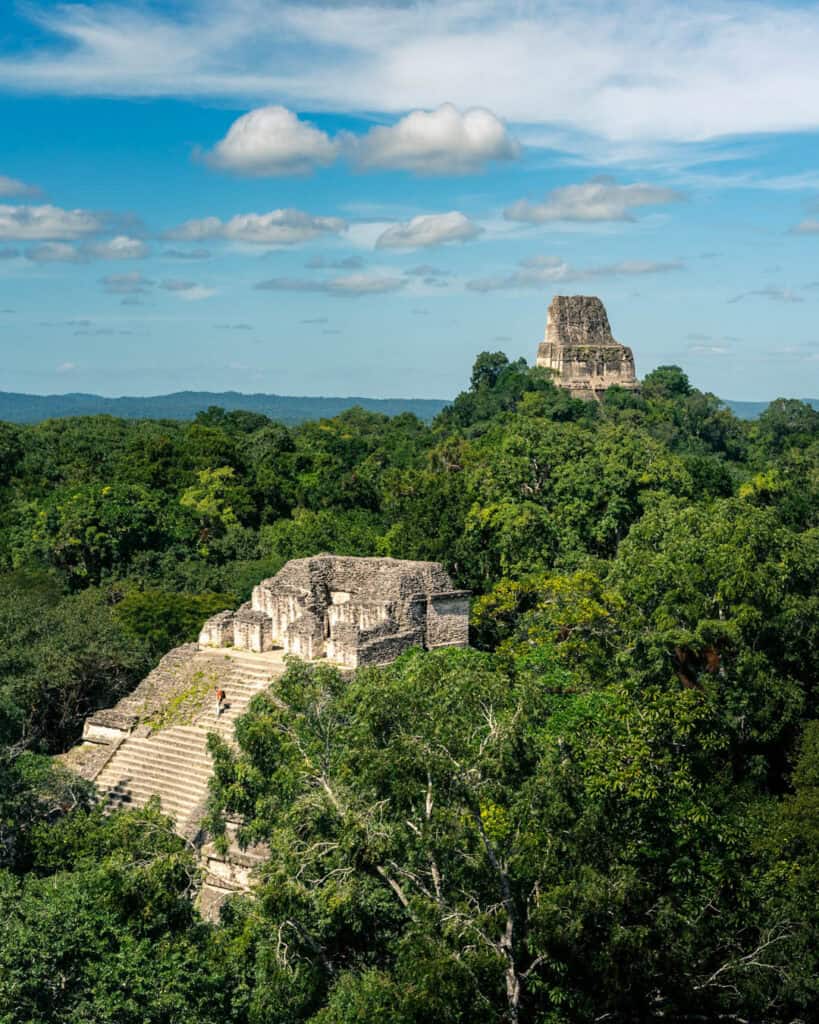
It was one of the temples within the Lost World Complex, a group of structures used for astronomical observations and tracking important events such as the equinoxes.
Part of the reason it stood out was because you can climb it.
Temple IV provides the better view.
But the Lost World Complex was the structure that made me appreciate the engineering involved.
Standing at the base and looking up, the staircase feels almost absurdly steep.
Climbing it gives you a much better appreciation of the scale of these structures than simply viewing them from the ground.
What fascinated me most wasn’t just that the Maya were tracking the equinoxes, but that there were actually multiple observation structures built over time.
Our guide explained that the alignment of the original structures became slightly less accurate as the Earth’s axial tilt gradually changed over long periods of time.
Rather than simply accepting the discrepancy, the Maya recognised it and constructed new observation points with improved alignments.
Standing there, it’s difficult not to be impressed.
The accuracy of these structures, combined with how well they’ve survived the passage of time, is one of those moments that makes you stop and wonder how they achieved it all.
Of course, I don’t subscribe to any of the wild conspiracy theories you sometimes see online about ancient civilisations. But standing in front of structures that were accurately tracking astronomical events centuries ago without modern technology does make you appreciate just how advanced the Maya really were.
It’s even more remarkable when you consider that most of us would struggle to drive somewhere unfamiliar without opening Google Maps, yet they were measuring celestial movements with a level of precision that still impresses people today.

Why The Staircases Are So Impressive
Photos don’t prepare you for how steep some of the temple staircases actually are.
Looking up from the bottom, many appear almost vertical.
Looking down is even worse.
What surprised me most wasn’t just the height of the temples but how difficult some of the staircases are to climb.
On several structures, the steps are so tall and steep that most people can’t simply walk up them normally.
Instead, you’re almost scrambling your way upwards, using your hands for balance and taking one step at a time.
Even as a fairly tall person, there were sections where the steps felt awkwardly high.
At one point our guide actually challenged the group to walk down one of the temple staircases completely normally rather than turning sideways or carefully stepping down one level at a time.
Almost nobody could do it.
The drop between each step is so large that walking down normally feels as though you’re almost falling forward with every stride.
Most people instinctively turn slightly sideways and lower themselves down each step, almost like performing controlled step-downs in the gym.
It’s one of those experiences that’s difficult to appreciate from photographs.
The staircases look steep in pictures, but you don’t truly understand the scale until you’re standing on them yourself.
The experience gives you a much greater appreciation for the structures themselves.
From ground level it’s easy to think of them as oversized staircases.
Once you’re actually climbing them, you realise just how enormous they are.
Our guide explained that many of these temples were intended for rulers, priests, and elite members of Mayan society.
Descending from these towering structures in front of the crowds below would have been an unmistakable display of status and authority.
Standing on those staircases yourself, it’s surprisingly easy to imagine the effect.
Wildlife In Tikal National Park
While the ruins understandably receive most of the attention, Tikal is also one of the best places in Guatemala to experience wildlife.
The surrounding rainforest is home to howler monkeys, spider monkeys, coatis, hundreds of bird species, and even jaguars.
Even when you can’t see wildlife, you’re constantly aware of it.
The jungle never feels empty.
You hear movement in the trees. Calls echo through the canopy. Birds appear and disappear between branches.
It creates a feeling that the ruins and rainforest are still sharing the same space rather than existing separately.
Unfortunately, jaguar sightings are extremely rare.
However, during our visit, our guide showed us a video on his phone of a jaguar that had recently been spotted near the ruins.
In the footage, the animal emerged from the vegetation close to a tour group before disappearing back into the forest.
Knowing animals like that still move through the jungle adds another layer to the experience.
Even if you never see one yourself, it’s a reminder that Tikal isn’t just an archaeological site.
It’s also a functioning ecosystem.
How Long Do You Need At Tikal?
For most travellers, one full day is enough.
That’s exactly what I did, and I never felt rushed.
That said, don’t underestimate how much ground you’ll cover.
A typical visit involves several hours of walking, plenty of stops, and more than enough time to see the highlights.
By the end of the day, I had walked more than 20,000 steps.
If you’re staying in Flores, I’d dedicate one full day to Tikal and then spend the rest of your time exploring the town itself.
If you’re planning a shorter route through the country, I cover how Tikal fits into a 2 week Guatemala itinerary in a separate guide.
Sunrise vs Day Tours
One of the biggest decisions visitors face is whether to choose a standard daytime tour or a sunrise experience.
I opted for the standard daytime tour.
The weather forecast on the morning of my visit wasn’t particularly promising, and with sunrise departures typically requiring a very early start from Flores, I couldn’t justify sacrificing several hours of sleep for a sunrise that was likely to be hidden behind cloud.
In hindsight, I still think it was the right decision for that particular day.
That said, almost every traveller I spoke to who completed the sunrise tour described it as one of the highlights of their trip.
Walking through the jungle before dawn while hearing howler monkeys echoing through the darkness sounds like an incredibly immersive experience.
With fewer people around and the rainforest slowly waking up around you, I can absolutely see why it’s so highly rated.
If the forecast looks clear and you don’t mind an extremely early alarm, the sunrise tour is probably worth considering.
If not, don’t worry.
The standard daytime experience is still exceptional.
Is Tikal Better Than Chichén Itzá?
Having visited both, my answer is yes.
That’s not to say Chichén Itzá isn’t impressive.
It absolutely is.
But I found Tikal far more memorable.
Chichén Itzá felt like I was visiting a world-famous monument.
Tikal felt like I was exploring something.
Both are impressive.
Only one made me feel like an adventurer.
Part of that comes down to the setting.
Tikal is surrounded by rainforest, wildlife, and jungle trails, creating a much more immersive experience.
Tikal also feels larger.
The site covers a huge area, and spending the day walking through the forest between temples creates a genuine sense of exploration.
Most importantly, Tikal still feels raw.
There are temples partially hidden beneath vegetation.
There are structures that remain unexcavated.
There are moments where you genuinely feel as though you’re discovering something rather than simply observing it.
If I could only visit one set of ruins in Central America, I’d choose Tikal without hesitation.

Do You Need A Guide For Tikal?
Technically, no.
Realistically, yes.
The site is enormous, and much of what makes Tikal fascinating isn’t immediately obvious.
Without a guide, it’s easy to walk past important structures without understanding their significance or miss the stories that bring the city to life.
Our guide explained everything from astronomical alignments and Mayan society to wildlife and recent discoveries within the park.
He also helped us navigate the huge site efficiently, ensuring we saw the most impressive areas without wasting time.
If you only have one day at Tikal, I’d strongly recommend visiting with a guide.
Final Verdict
Of all the archaeological sites I’ve visited, Machu Picchu is probably the closest comparison to Tikal.
Both combine ancient ruins with dramatic natural surroundings, and both feel more like adventures than sightseeing attractions.
If I’m being honest, Machu Picchu is the stronger overall experience. It’s one of the most famous places in the world for a reason, and the hype is largely justified.
But Tikal isn’t far behind.
What makes Tikal special is the same thing that makes places like Machu Picchu, Herculaneum, and the Colosseum so memorable: they make history feel real.
At all four sites, it’s easy to imagine the people who once lived there, walked the streets, or climbed the structures you’re standing on today.
Tikal achieves that in a particularly unique way because of its setting.
The rainforest isn’t a backdrop.
It’s part of the experience.
You hear it. You walk through it. You constantly interact with it.
The result is a place that feels less like a museum and more like a lost city that the jungle is still slowly revealing.
If you’re travelling through Guatemala or Belize, I genuinely think Tikal is one of the experiences you shouldn’t miss.
If you’re still deciding where it fits into your route, my guide to the best places to visit in Guatemala will help you plan the rest of your trip.
FAQs About Visiting Tikal
Is Tikal worth visiting?
Absolutely. If you’re travelling through Guatemala or Belize, Tikal is one of the most memorable experiences in the region.
Can you visit Tikal without a guide?
Yes, but I would strongly recommend visiting with one. The site is enormous and a guide adds a huge amount of context.
How much does Tikal cost?
Expect to pay the entrance fee plus transport or tour costs. For me, the total came to around 288 quetzals.
How difficult is Tikal?
Not particularly difficult, but it is tiring. Expect a long day, plenty of walking, heat, humidity, and some very steep staircases.
Is Tikal better than Chichén Itzá?
Having visited both, I preferred Tikal due to its scale, wildlife, rainforest setting, and lower crowds.
Can you climb the temples at Tikal?
Some of them, yes. However, not every structure is accessible and some of the staircases are far steeper than they appear in photographs.