If you’ve been researching the Acatenango hike, you’ve probably seen completely different distances quoted depending on which website you’re reading.
One says 6.5km.
Another says 13km.
I’ve even seen figures pushing 20km.
Which isn’t particularly helpful when you’re trying to work out what you’re actually signing up for.
The reason for the confusion is that all of those numbers are technically correct.
The most commonly quoted distance of 6.5km only refers to the climb from the trailhead to basecamp. To get back down again you’ll need to hike another 6.5km. Add the optional Fuego Ridge hike and sunrise summit hike, and the total distance can exceed 20km over two days.
Different tour companies also use different campsites around the mountain. Everyone follows essentially the same route for most of the climb, but near the top the trail begins to split depending on where your company’s camp is located.
So if you’re wondering how long the Acatenango hike really is, here’s the short answer.

Contents
- Acatenango Distance: Quick Answer
- Why Do Websites Quote Different Distances?
- Breaking Down The Acatenango Distance
- How Many Steps Is The Acatenango Hike?
- How Does Acatenango Compare To Other Hikes?
- How Long Does The Acatenango Hike Take?
- Which Part Of Acatenango Feels Hardest?
- The Distance Isn’t What Makes Acatenango Hard
- My Biggest Mistake When Judging The Acatenango Distance
- Acatenango Distance FAQs
Acatenango Distance: Quick Answer
| Trailhead to Basecamp | 6.5km |
| Basecamp to Trailhead | 6.5km |
| Fuego Ridge Hike | 5km return |
| Summit Hike | 3.4km return |
| Total Distance | 13km–21km depending on your route |
But after hiking Acatenango myself, I don’t actually think distance is the statistic that matters.
There are plenty of longer hikes that feel easier.
What makes Acatenango difficult is the combination of steep elevation gain, loose volcanic terrain, altitude and carrying a backpack for much of the route.
If you’re trying to work out whether you’re capable of completing it, I’d focus less on the kilometres and more on the difficulty. I’ve covered that in detail in my guide on how hard the Acatenango hike really is.
And if you’re still planning your hike, including costs, tour companies, packing lists and whether it’s actually worth doing, you’ll find everything in my complete Acatenango hike guide.

Why Do Websites Quote Different Distances For The Acatenango Hike?
One thing I didn’t realise before doing the hike is that not every tour company camps in the same place.
Everyone starts from roughly the same trailhead.
Everyone follows essentially the same route for most of the climb.
But once you reach the upper slopes of the mountain, the trail begins to split.
Different tour companies have camps positioned at different points around Acatenango.
Some camps sit closer to the main route.
Others require a longer traverse around the mountain before reaching camp.
That means two people can complete the Acatenango hike and finish with different total distances.
The annoying answer is that it depends.
The exact distance varies based on:
- Your tour company.
- The location of your campsite.
- Whether you do the Fuego Ridge hike.
- Whether you do the sunrise summit hike.
That’s why you’ll see distances ranging from around 13km to more than 20km depending on where you’re looking.
Breaking Down The Acatenango Distance
Rather than thinking of Acatenango as one hike, it’s easier to think of it as four separate hikes spread across two days.
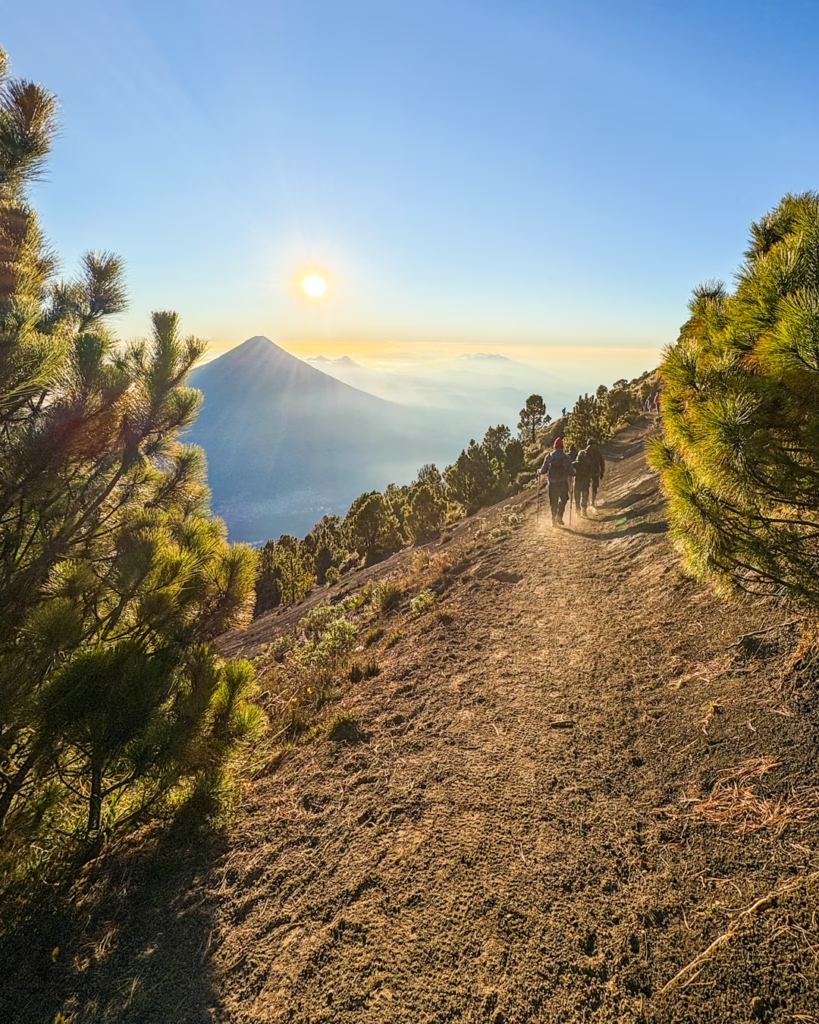
1. The Main Climb To Basecamp (6.5km)
This is the longest continuous climb of the entire experience.
It’s also the point where you’re carrying the most weight.
Your backpack contains your water, snacks, warm layers and overnight gear.
The climb gains roughly 1,500 metres in elevation and usually takes between four and six hours.
This is the section most people are talking about when they describe Acatenango as difficult.
Not because it’s the longest distance.
But because it’s relentlessly uphill and you’re carrying everything you need for the night.
2. The Fuego Ridge Hike (5km Return)
Most hikers complete the Fuego Ridge hike after arriving at basecamp.
On paper, it’s another 5km added to your day.
In reality, I found it significantly easier than the main climb.
By this point you’ve:
- Already eaten some of your food.
- Left your overnight gear at camp.
- Reduced the weight you’re carrying.
- Had time to recover.
The route drops down into the saddle between Acatenango and Fuego before climbing back towards the ridge overlooking the volcano.
It’s still hard work, but the experience feels completely different.
You’re walking towards one of the most active volcanoes in Central America, and every few minutes there’s a chance you’ll hear another eruption.
For me, the excitement outweighed the fatigue.
3. The Sunrise Summit Hike (3.4km Return)
The summit hike is relatively short.
But distance can be deceptive.
This was the steepest section of the entire trip.
You leave camp in darkness before sunrise and climb another few hundred metres towards Acatenango’s summit.
The terrain becomes looser, the air becomes thinner and every step feels harder than it should.
My Whoop actually classified this section as a Stairmaster workout rather than a hike.
That probably tells you everything you need to know about the gradient.
The reward is standing at nearly 4,000 metres watching the sun rise over Guatemala while Fuego continues erupting beside you.
It’s one of those travel moments that genuinely lives up to the hype.
4. The Descent (6.5km)
This is the section most people underestimate.
The climb gets all the attention.
The descent deserves far more respect.
After watching sunrise from the summit, we returned to basecamp, had breakfast, packed up and started heading down.
We left the summit at roughly 6:50am and were back in Antigua around midday, including the drive back from the trailhead.
Physically, the descent doesn’t feel as demanding as the climb.
But it creates a completely different type of fatigue.
Hour after hour of downhill hiking puts a constant load through your knees and joints.
By the bottom, my lungs felt better than they had the previous day.
My knees definitely didn’t.

How Many Steps Is The Acatenango Hike?
Distance only tells part of the story.
According to my Whoop, I recorded more than 67,000 steps during the full Acatenango experience.
- Day 1: 33,142 steps
- Day 2: 34,039 steps
That included:
- The climb to basecamp.
- The Fuego Ridge hike.
- The sunrise summit hike.
- The full descent.
That’s one reason Acatenango often feels bigger than the distance suggests.
Even if your total distance ends up being around 16-21km, you’re climbing, descending and walking for far longer than most people expect.
The kilometres themselves aren’t particularly outrageous.
The terrain, elevation gain and amount of time spent on your feet are what make the experience feel much larger than the numbers suggest.
How Does Acatenango Compare To Other Hikes?
The distance itself isn’t particularly unusual.
What makes Acatenango stand out is how much climbing is packed into that distance.
| Hike | Distance | Elevation Gain |
|---|---|---|
| Snowdon (Pyg Track) | ~11km | ~700m |
| Ben Nevis Mountain Track | ~17km | ~1,300m |
| Acatenango (Basecamp Return) | ~13km | ~1,500m |
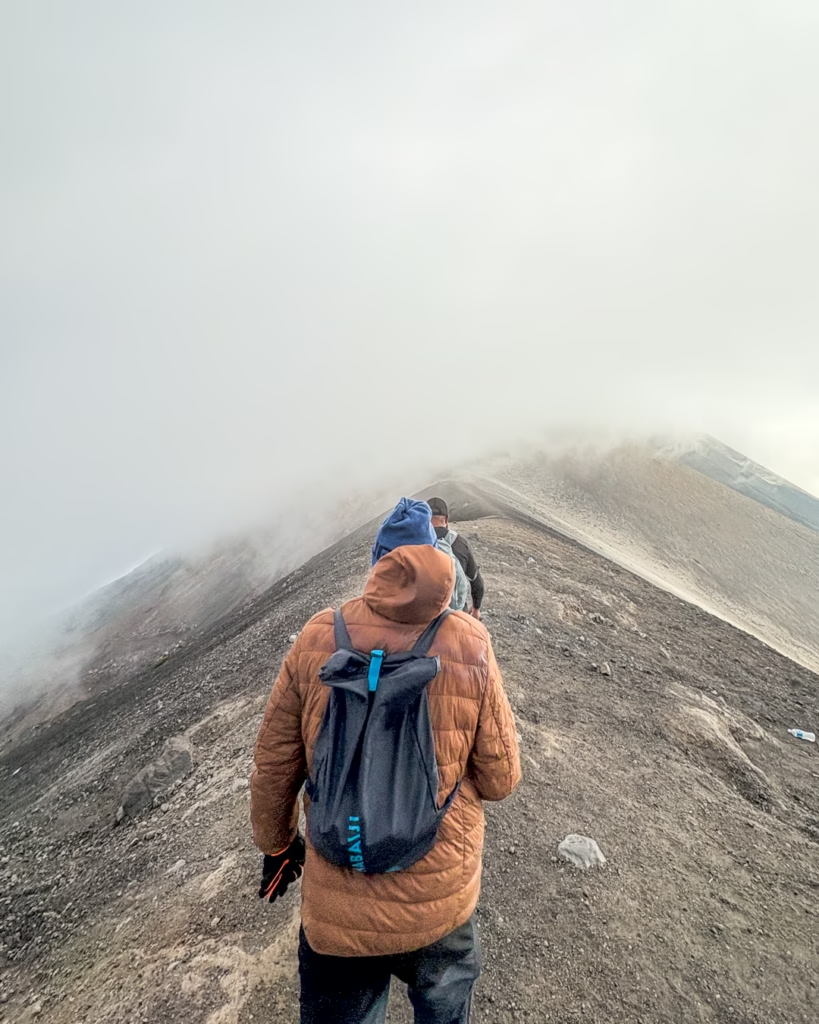
On paper, Acatenango doesn’t look dramatically longer than many popular UK hikes.
What surprised me was how much harder it felt.
The combination of altitude, volcanic terrain and sustained climbing makes the mountain feel significantly bigger than the distance alone suggests.
How Long Does The Acatenango Hike Take?
The distance is only half the story.
What most people really want to know is how long they’ll actually spend hiking.
| Trailhead to Basecamp | 4-6 hours |
| Fuego Ridge Hike | 2-3 hours |
| Sunrise Summit Hike | 1.5-2 hours |
| Descent | 3-4 hours |
In total, you’ll probably spend somewhere between 10 and 15 hours actually hiking across the two days.
That’s another reason Acatenango catches people out.
On paper, a 13-21km hike doesn’t sound outrageous.
But when that distance is spread across steep climbs, volcanic gravel, altitude and a sunrise summit push, it feels considerably bigger than the numbers suggest.
Which Part Of Acatenango Feels Hardest?
Based purely on my own experience, I’d roughly break the challenge down like this:
| Main climb to basecamp | ~50% |
| Fuego Ridge hike | ~15% |
| Summit hike | ~15% |
| Descent | ~20% |
This isn’t scientific.
It’s simply how the hike felt to me.
The climb to basecamp is the biggest challenge, but it isn’t the whole challenge.
Acatenango is one of those hikes where every section demands something slightly different from you.
The Distance Isn’t What Makes Acatenango Hard
If there’s one thing I’d want people to take away from this article, it’s this:
Acatenango isn’t difficult because it’s long.
It’s difficult because it packs an enormous amount of climbing into a relatively short distance.
The distance sounds intimidating, but it’s actually the climbing that catches most hikers out. Acatenango gains more elevation than Ben Nevis and the total climbing effort feels even greater once you include the Fuego Ridge hike and summit push. I’ve broken down the full Acatenango elevation gain here.
Before doing the hike, I spent far too much time looking at the kilometres and not enough time looking at the elevation profile.
I assumed that if I was comfortable walking 15-20km, I’d be fine.
What I completely underestimated was how different 15-20km feels when much of it is uphill, you’re carrying a backpack and you’re hiking above 3,500 metres.
The distance is manageable for most reasonably fit travellers.
The elevation gain, altitude and terrain are what catch people out.
If you’re trying to decide whether you’re capable of completing the hike, I’d strongly recommend reading my guide on how hard the Acatenango hike really is.
My Biggest Mistake When Judging The Acatenango Distance
Before doing Acatenango, I thought the distance would tell me everything I needed to know.
After all, most hiking guides focus heavily on kilometres.
The problem is that distance only tells part of the story.
Walking 20km on a relatively flat trail is very different from walking 20km on a volcano while carrying a backpack and climbing more than 1,500 metres.
Looking back, I think I asked the wrong question.
I should have been asking how much climbing was involved rather than how many kilometres I’d be walking.
That’s ultimately what makes Acatenango one of the hardest and most rewarding hikes I’ve ever done.
The distance sounds intimidating until you realise there are plenty of longer hikes around the world.
The elevation gain is what makes Acatenango memorable.
If you’re still planning your hike, I’d recommend reading my complete Acatenango hike guide, which covers tour companies, costs, accommodation, packing lists and everything else you need to know before booking.
Acatenango Distance FAQs
How long is the Acatenango hike in miles?
The exact distance depends on your route and tour company.
- Basecamp only: approximately 8 miles (13km)
- Basecamp plus summit: approximately 10.2 miles (16.4km)
- Basecamp plus Fuego Ridge: approximately 11.2 miles (18km)
- Full hike including Fuego Ridge and summit: approximately 13.3 miles (21.4km)
Why do different websites give different Acatenango distances?
Different tour companies use different campsites around the mountain, which changes the overall distance. Some websites also only quote the distance to basecamp, while others include the optional Fuego Ridge and summit hikes.
Can you hike Acatenango in one day?
Yes, some companies offer day hikes. However, most travellers complete Acatenango over two days so they can experience the Fuego eruptions after dark and watch sunrise from the summit.
Is the Fuego Ridge hike included in the total distance?
Not always.
Many websites only quote the distance to basecamp. If you complete the Fuego Ridge hike, you’ll add roughly 5km to your total distance.
How far is the hike to Acatenango basecamp?
The hike from the trailhead to basecamp is approximately 6.5km. Most hikers complete this section in four to six hours depending on fitness, weather and trail conditions.
What is more important: the distance or the elevation gain?
For most hikers, the elevation gain is the bigger challenge.
The distance itself is manageable.
Climbing around 1,500 metres on loose volcanic terrain while carrying a backpack is what makes Acatenango feel difficult.