Guatemala Itinerary (7, 10, 14 Days): How to Plan Your Trip Around Acatenango & Fuego

If there’s one experience that defines a trip to Guatemala, it’s standing on the side of Acatenango watching Volcán Fuego erupt.

Not from a distance.
Not from a viewpoint you drove to.

But after a full day of climbing — cold, tired, and completely exposed to it.

Every 20–30 minutes, the volcano explodes.
Lava shoots into the sky.
The sound rolls across the valley long after the eruption ends.

It doesn’t feel like a sightseeing stop.

It feels raw.

Volcan de Fuego erupting into the clear night sky

Reality Check: Guatemala isn’t one kind of trip — it’s intense, slow, and can be exhausting if planned badly.

If you want to see everything, you need around 3 weeks.

If you’re on a shorter trip, don’t waste half of it sitting on buses trying to force it all in.

How to Plan Your Guatemala Itinerary

Every Guatemala itinerary works best when you think of it in two parts:

– Your Core (Non-Negotiable)

This is the backbone of the trip. You need around 5 days to do this properly.

– Your Add-Ons (Choose Based on Time)

Not all of these are equal. And trying to do all of them in one trip is where people get it wrong. For a full breakdown of what each itinerary actually costs, check out my Guatemala travel budget guide
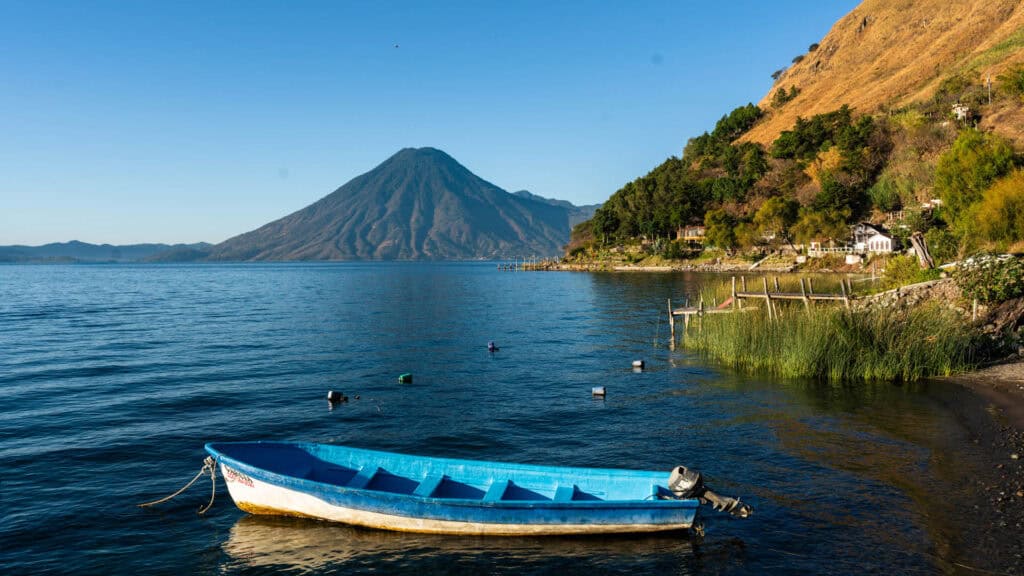
A lone canoe floating on Lake Atitlan with towering volcanoes in the background

The Reality Most People Underestimate

Guatemala looks small on a map.

It isn’t.

If you include both Semuc Champey and Flores, you’re basically resigning three full days to transport alone.

That’s a huge chunk of a short trip.

That’s not to say you can’t visit them on a shorter trip.

But it’s only really worth it if ruins or nature are the main reason you’re coming to Guatemala.

If you want a full overview of what travelling through the country is actually like — including safety, costs, and what each destination is really like — read my Guatemala travel guide.


Before planning your route, it’s worth understanding how transport actually works here—this guide on how to get around Guatemala will save you a lot of time.


Antigua & Acatenango (Your Non-Negotiable Core)

Antigua is where your trip starts. If you’re flying into Guatemala City — especially on a long-haul flight — this is the obvious place to start.
  • Close to the airport
  • Easy to settle into
  • Perfect for recovering from travel and adjusting to altitude
You need:
  • a couple of days before the hike
  • 2 days 1 night Acatenango Hike
  • at least some time after
You can rush it. But I Wouldn’t recommend it.   I did: 2 nights → hike → shower → night out → early shuttle Not ideal.   If you’re really limited on time, you can even leave for Lake Atitlán the same day you come down from Acatenango. But:
  • you’ll likely have no proper shower
  • you’ll be rushed on timings
  • and it’s not how I’d recommend doing it
The middle ground is 4 nights total. But if you have flexibility, 5 nights total (with 2 nights after Acatenango) makes a noticeable difference. You actually get to enjoy Antigua — not just pass through it. 👉 Read my full Antigua Guatemala travel guide
A Tuc Tuc passing through the Santa Catalina Arch in Antigua Guatemala with the volcano behind partially obscured by clouds

Acatenango (The Reason This Trip Works)

For me, this was the highlight of Guatemala.

The climb is harder than expected.
The cold hits more than you think.
And by the time you’re standing there watching Fuego erupt across the valley, it feels earned.

That effort → reward ratio is what makes it stick.

If you only do one thing in Guatemala, this should be it.

👉 Read my complete Acatenango hike guide

a photo of the view from the OX expedition basecamp over Volcan de Fuego with a hiker holding banana bread in the foreground

Choosing Your Route (This Is Where Your Trip Changes)

Once you’ve done your core, your trip splits.

Most people end up choosing between adding somewhere like Lake Atitlán or El Paredón for a more relaxed route — or committing to longer travel days to reach places like Semuc Champey and Flores & Tikal.


All of the time recommendations here include the time needed to get to each place.

You’re not just budgeting for time spent there — you’re also accounting for getting there and leaving again.

That’s where a lot of itineraries fall apart.

Lake Atitlán (Best Overall Choice)

This is the easiest addition — and for most people, the best one.

It’s flexible, relatively easy to reach, and works for almost any travel style.

What I’d do:

  • Stay 3–4 days
  • Pick one base
  • Explore other towns by boat

If you move every night, it gets tiring quickly.

If you’re doing Spanish school:

  • this becomes a 7–10 day stop
  • and can be added onto almost any itinerary

👉 Read my Lake Atitlán travel guide

The view from the balcony of Free Cervesa hostel on Lake Atitlan in Guatemala with three paddle boarders enjoying the tranquil waters

El Paredón (The “Do Nothing” Ending)

El Paredón feels completely different to the rest of Guatemala.

There’s no big checklist here.

It’s just:
surf
eat
sunset
repeat

I stayed 7 nights.

You definitely don’t need that long — but it’s the kind of place where leaving feels unnecessary.

This was actually my favourite place in Guatemala.

But at the same time, it added very little in terms of understanding the country itself.

It’s not about culture or sights — it’s about switching off completely.

Realistically:
3 days is enough
more if you want to fully switch off

If your trip is more culture-focused, this is the easiest place to skip.


👉 Read my full El Paredón travel guide

A lone surfer riding a wave infant of an incredible sunset in El paredon, Guatemala

Semuc Champey (Worth It — But Comes at a Cost)

The place itself lives up to expectations.

The journey to get there also lives up to expectations — just in a different way.

It’s long, it’s tiring, and it breaks the flow of your trip.

If you’re unsure whether it’s worth the effort, I break that down fully in my Semuc Champey: is it worth it? guide.


What to know:

  • You need at least 4 days
  • It’s not something you casually add in
  • Best suited to longer trips

👉 Read my full Semuc Champey guide

A single tourist taking photos from the viewpoint at Semuc Champey, with incredible views down onto the lakes

Flores & Tikal (Incredible — But Logistically Heavy)

Tikal is one of the most impressive experiences in Guatemala.

But getting there takes commitment.

I did 2 nights in Flores — and it felt rushed.

And that was coming from Belize.

If you’re coming from somewhere like Antigua, rushing this becomes even more noticeable.

Realistically:

  • 4 days total works well
  • less than that feels compressed

👉 Read my Flores & Tikal guide

A single tourist climbing the steep stairs of the temples in Tikal national park, surrounded by the jungle and other temples

My Actual Route (What I Did + What I’d Change)

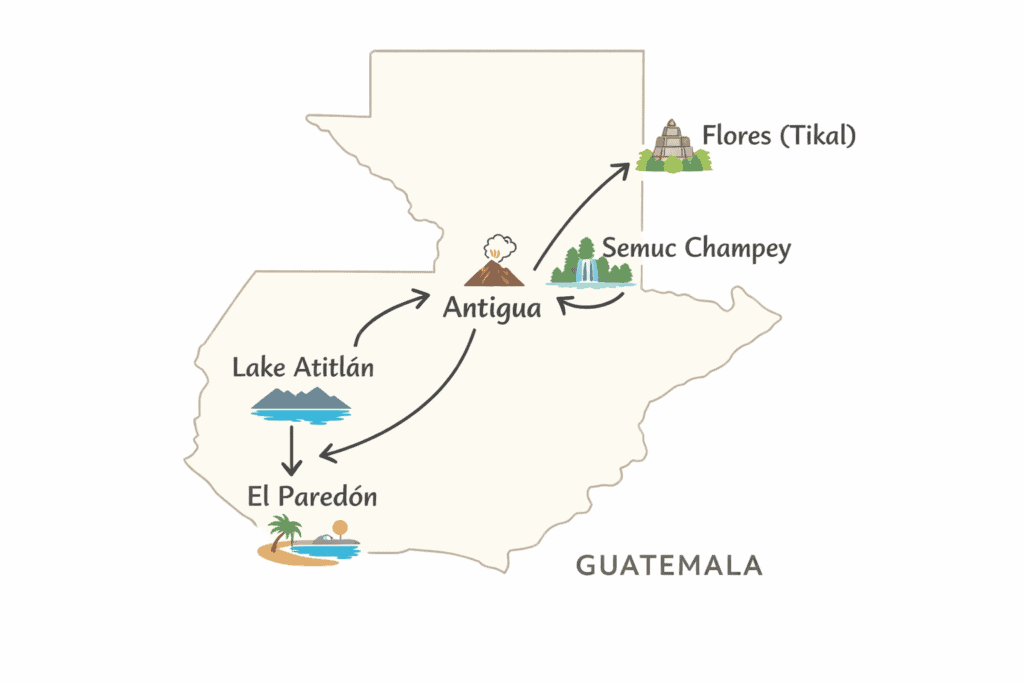
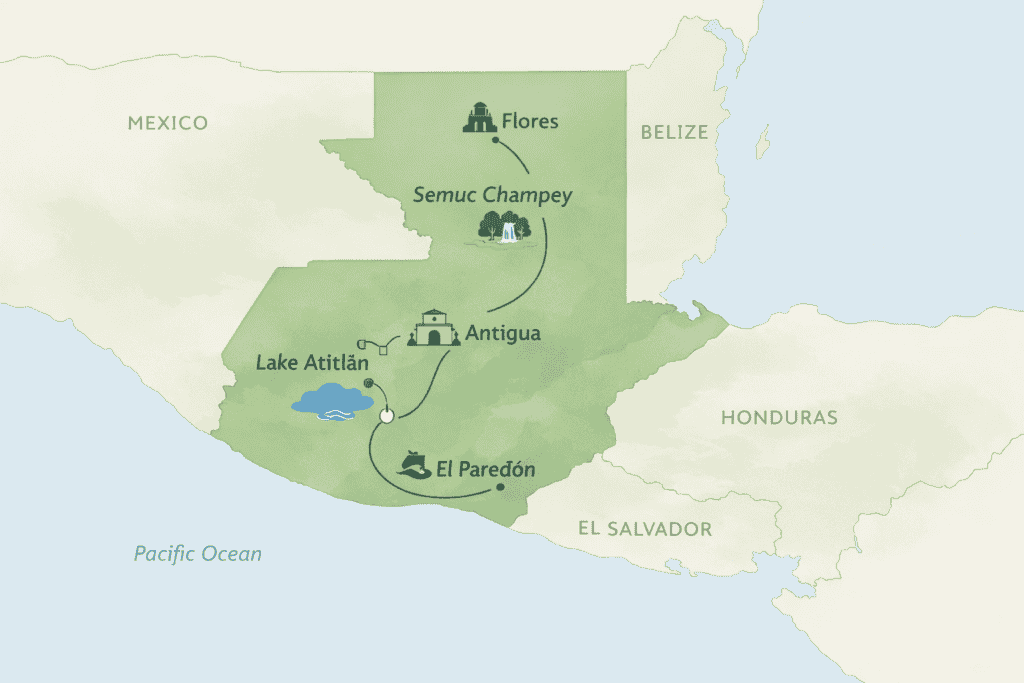
Belize → Flores → Semuc → Antigua → Acatenango → Lake Atitlán → El Paredón

What I’d change:

  • Add 1 more night in Antigua after Acatenango
  • Give Flores more time
  • Be more intentional with extra days
a map showing my route through Guatemala as a backpacker

7 Day Itinerary

10 Day Itinerary

14 Day Itinerary

Option A: Option B:

The Ideal Guatemala Itinerary (3 Weeks)

  • Antigua (2–3 nights)
  • Acatenango (1 night)
  • Antigua (2 nights)
  • Semuc Champey (4 nights)
  • Flores (4 nights)
  • Lake Atitlán (4 nights)
  • El Paredón (3–4 nights)

If you add Spanish school in Lake Atitlán (around 1 week), this becomes a 4 week itinerary.

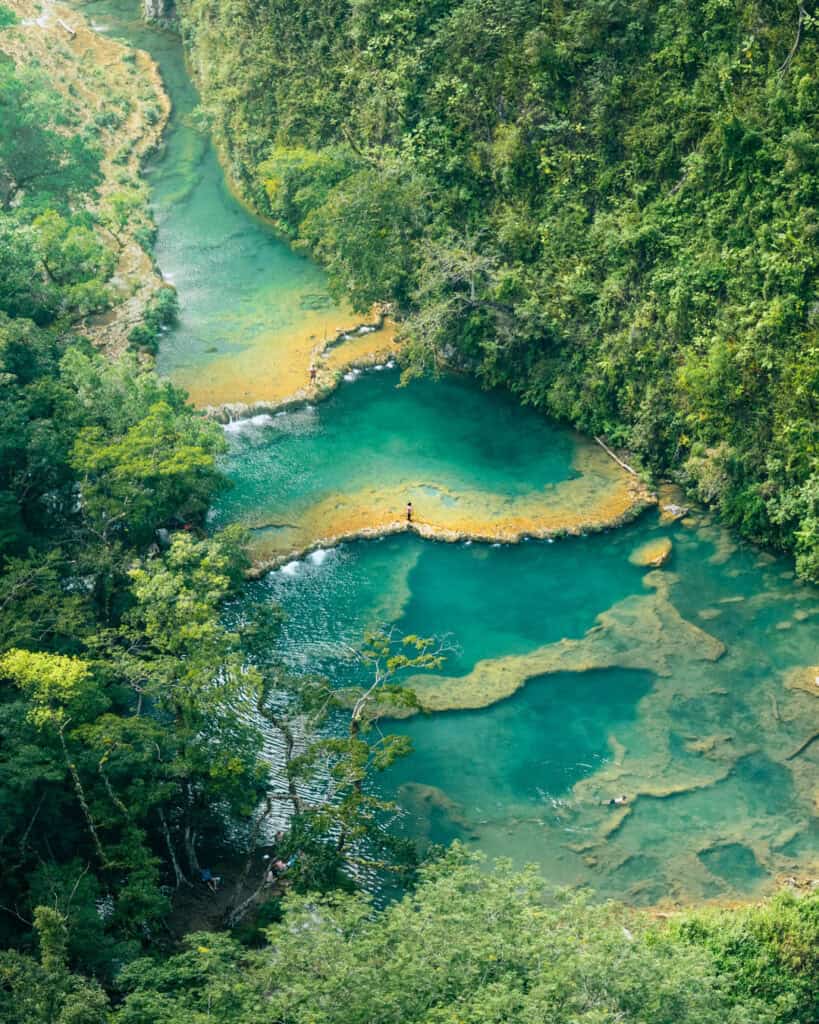
The stunning view of Semuc Champey from above with a lone traveler stood in the middle of the terraced pools

Final Thought

The biggest mistake people make here isn’t choosing the wrong places.

It’s choosing too many.

Pick your core.
Add what fits your time.
Accept what you’re leaving out.

That’s what makes the trip actually work.

Verified by MonsterInsights