Is Guatemala safe for tourists in 2026?
Yes — Guatemala is generally safe for tourists, but it’s not somewhere you should completely switch off. Staying aware, especially at night and in unfamiliar areas, is important.
- Safe on well-travelled routes
- Petty crime exists but is avoidable
- Most travellers experience no issues
- Biggest risk is complacency, not danger
I went in expecting a country that wasn’t overly dangerous, but also not somewhere you could fully switch off and relax at all times. Somewhere in that middle ground where you stay aware, especially at night.
But as the trip went on, something shifted.
Not because anything happened—but because nothing did.
The longer I stayed, the more relaxed I became. Conversations with locals—especially my host family in Lake Atitlán—only reinforced that feeling. They spoke about the country with confidence, not caution.
And that’s where the only real “risk” started to creep in.
Not danger—but complacency.

Is Guatemala Safe for Tourists in 2026?
Yes — Guatemala is generally safe for tourists, but safety depends on how you travel and how aware you stay.
But it’s not the kind of place where you should completely switch off. It’s closer to how you’d act in a UK city at night. You’re not constantly on edge, but there’s still a level of awareness running in the background. If you’re planning a full trip, this 2-week Guatemala itinerary keeps you on the safer, well-travelled route.How Safe Guatemala Actually Felt
There wasn’t a single moment on the trip where I felt directly threatened.
No scams. No confrontations. No situations that escalated beyond a passing thought of “this feels a bit off.”
I don’t remember anyone ever trying to scam me, other than ridiculous card fees, no negative encounters or bad experiences at all.
If anything, what stood out most was how normal it felt.
Walking around Antigua during the day felt easy—almost surprisingly so. It’s not packed shoulder-to-shoulder like European tourist hotspots, so you don’t get that constant low-level paranoia about pickpockets.
If you’re planning time there, read my full Antigua Guatemala travel guide.
At night, it didn’t suddenly change either. Restaurants were still busy, people still out, and the atmosphere stayed relaxed.
But after one night out, when people suggested heading to an afterparty outside the city, several locals recommended we didn’t go and said it was best to stay within the inner city late at night.
Nothing dramatic. Just a quiet “don’t go there.”
The Only Time I Felt Slightly On Edge
The one moment that stands out happened on my first night in San Juan, Lake Atitlán.
I’d just been dropped off and had to find my homestay on foot.
It was dark, quiet, poorly lit, and not on a main tourist path. One of those walks where every sound feels louder than it should, and you become very aware of the fact you don’t really know where you are.
Then came the real obstacle.
A lary chihuahua.
Barking, standing its ground, fully committed to not letting me pass.
In the end, a local nearby casually picked up a small stone, tossed it in the dog’s direction—not to hit it, just to scare it—and it immediately backed off.
And that was it.
No confrontation. No hostility. Just a strangely memorable introduction to walking alone at night in Guatemala.
Looking back, that moment says more than anything else: the environment can feel uneasy—but the people rarely are.
A few days later, that same walk felt completely different.

Lake Atitlán: Safe, With One Important Exception
Aside from that first walk, Lake Atitlán felt safe across the board.
San Marcos and Santa Cruz were calm, relaxed, and very obviously built around travellers. Nothing about them felt threatening.
In San Pedro there’s a noticeable police presence at night with several officers carrying guns. It’s the more party-focused town, and it felt more like they were there to keep things under control rather than respond to danger.
If you’re heading there, this Lake Atitlán travel guide breaks down what each village actually feels like.
The only thing that genuinely stuck with me at Atitlán wasn’t crime-related at all.
It was a lancha accident.
While I was there, a boat capsized and several people died. It was a combination of a storm, strong winds, an inexperienced driver, and people crowding one side of the boat which unbalanced it.
After that, I felt slightly uneasy taking lanchas for the rest of the trip.
It also made me more aware of where the life jackets were on each boat—because they’re not always in the same place and not always obvious.

Semuc Champey: Where Safety Isn’t Even a Thought
Semuc Champey is one of those places where you rarely leave the hostel unless you’re on a tour, so it’s hard to imagine where you’d even get into trouble.
I did venture into Lanquín town to try and get cash from an ATM. It was hectic, slightly chaotic, but never felt dangerous. Everyone was friendly and trying to help me through broken Spanish.
Honestly, the most danger you’re likely to experience here isn’t crime—it’s something like the candlelit cave tour, which feels far more chaotic than anything else in Guatemala.
If you’re curious what that’s actually like, I wrote about it in my full Semuc Champey guide.
If you’re still deciding, here’s my take on whether Semuc Champey is worth visiting.

Small Places Feel the Safest
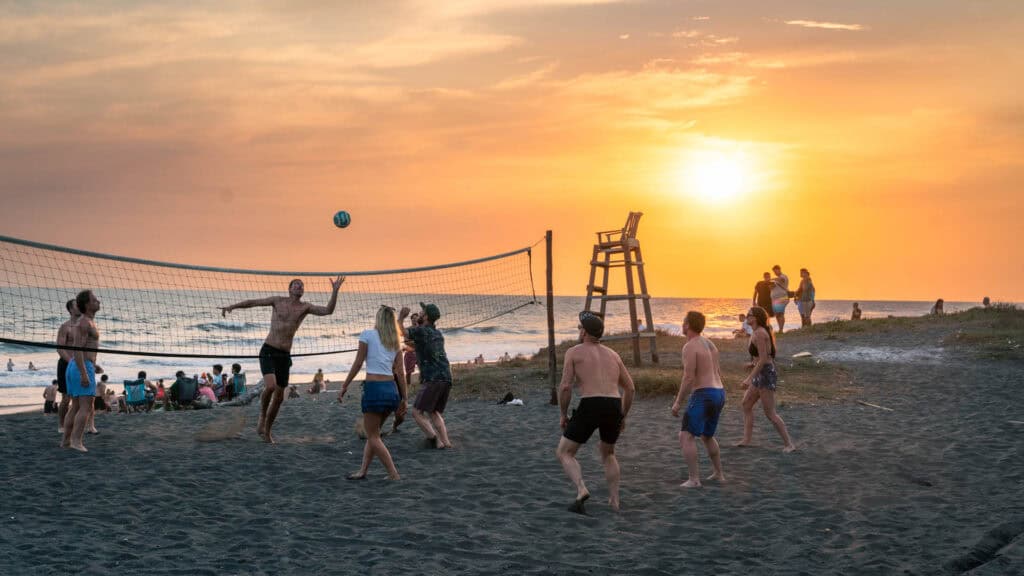
El Paredón felt incredibly safe. It’s so small and intimate that you’re never more than a couple hundred meters from your hostel—or 20–30 from any hostel.
It’s the kind of place where people leave their phones on the side of a volleyball court and don’t think twice about it.
If you’re heading there, here’s what El Paredón is actually like, plus whether it’s worth visiting.
Flores felt the same. Small, easy to navigate, and never gave me any reason to feel on edge.
This Flores & Tikal guide covers everything there.
Transport Safety
Transport felt completely safe throughout the trip.
Shuttles were reliable. Drivers definitely drive like the sooner they get there, the sooner they finish work—but not recklessly like in parts of Asia.
Tuk-tuks felt completely fine as well. You’ll mainly use them around Lake Atitlán and Lanquín. In Lanquín they feel slightly more intense because of the steep mountain roads, but it never felt unsafe.
I was warned by locals to avoid overnight buses. They’re few and far between anyway, so it’s easy enough to plan around.
If you’re planning logistics, this guide on how to get around Guatemala helps.

Things That Sound Worse Than They Actually Are
While I was in Guatemala, there were prison incidents near Guatemala City where gangs overthrew guards and triggered a state of emergency.
It sounds serious—and it is—but it never affected my trip in any way.
It was far removed from where I was travelling, and surprisingly it didn’t even reach UK news.
It’s a good reminder that what’s happening in a country doesn’t always reflect what you experience as a traveller.
Did Safety Affect My Trip?
Not once.
It didn’t limit where I went, what I did, or how I travelled.
In fact, I was often walking around with a professional camera over my shoulder and never had any issues.
If you’re budgeting, here’s my breakdown of Guatemala travel costs.
Final Verdict
Guatemala is safe.
Guatemala is safe if you stay aware, listen to local advice, and don’t do anything reckless.
Guatemala is not safe if you treat it like somewhere you can completely switch off.
Do that, and you’ll likely have the same experience I did:
Nothing dramatic. Nothing stressful. Just a country that turned out to be far less intimidating than expected.