Before hiking Acatenango, I spent far too much time looking at the distance and not enough time looking at the elevation gain.
That was a mistake.
Most websites will tell you the hike gains around 1,550 metres from trailhead to summit.
Technically, they’re right.
The trail starts at approximately 2,422 metres above sea level and climbs to Acatenango’s summit at 3,976 metres, giving a net elevation gain of roughly 1,554 metres.
What those numbers don’t tell you is how much climbing you actually end up doing.
By the time you’ve reached basecamp, hiked to Fuego, climbed to the summit for sunrise and walked back down again, the total amount of uphill walking feels considerably higher than the headline figure suggests.
That’s one reason Acatenango feels much harder than many hikes with similar distances.

Contents
- Acatenango Elevation Gain: Quick Answer
- Why Acatenango’s Elevation Gain Matters More Than Its Distance
- Acatenango Elevation Gain: Quick Comparison
- How Much Elevation Gain Does Acatenango Have?
- Why The Elevation Gain Feels Bigger Than The Numbers Suggest
- The Mountain Doesn’t Give You Every Metre You Climb
- What The Elevation Gain Actually Feels Like
- The Biggest Misconception About Acatenango’s Elevation Gain
- Elevation Gain vs Altitude
- Why The Summit Push Feels Different
- Which Is Harder: The Distance Or The Elevation Gain?
- Can Beginners Handle Acatenango’s Elevation Gain?
- FAQs
Acatenango Elevation Gain: Quick Answer
| Trailhead | 2,422m |
| Basecamp | 3,606m |
| Summit | 3,976m |
| Net Elevation Gain | 1,554m |
| Estimated Total Climbing Effort | Likely closer to 1,800-2,000m |
If you’re still deciding whether to do the hike, I’ve put together a complete Acatenango hike guide covering costs, tour companies, packing lists and what the experience is actually like.

Why Acatenango’s Elevation Gain Matters More Than Its Distance
Before hiking Acatenango, I assumed the distance would tell me how difficult it would be.
That was another mistake.
Most websites quote the hike at somewhere between 13km and 21km depending on your route and tour company.
Those numbers sound intimidating, but there are plenty of hikes around the world that are longer.
What makes Acatenango different is how much climbing is packed into that distance.
The summit sits 1,554 metres above the trailhead.
Once you factor in the Fuego Ridge hike, summit push and various ups and downs around the mountain, the actual climbing effort feels significantly higher.
That’s the statistic that explains why Acatenango feels so much harder than many hikes of a similar length.
Acatenango Elevation Gain: Quick Comparison
| Hike | Elevation Gain |
|---|---|
| Snowdon (Pyg Track) | ~700m |
| Scafell Pike | ~900m |
| Ben Nevis Mountain Track | ~1,300m |
| Acatenango (Net Gain) | ~1,554m |
| Acatenango (Estimated Total Climbing) | ~1,800-2,000m |
This was the moment the numbers finally made sense to me.
Acatenango isn’t just another volcano hike.
It gains more elevation than Ben Nevis while carrying overnight gear, and you’re doing that climbing after already starting at roughly 2,400 metres above sea level.
By comparison, Ben Nevis starts close to sea level.
That means you’re spending the entire hike operating at altitudes that most UK hikers never experience.
How Much Elevation Gain Does Acatenango Have?
The official figure most people quote is approximately 1,554 metres.
That’s calculated using the difference between the trailhead and the summit.
In practical terms, that means you’re climbing from 2,422 metres above sea level to nearly 4,000 metres.
For comparison, Ben Nevis gains around 1,300 metres from the visitor centre to the summit.
So even before considering altitude, Acatenango involves more climbing than the UK’s highest mountain.
The catch is that the elevation gain statistic only tells part of the story.
Why The Elevation Gain Feels Bigger Than The Numbers Suggest
Most websites quote Acatenango’s elevation gain as roughly 1,550 metres.
Technically, that’s correct.
But you don’t simply walk uphill for 1,554 vertical metres and stop.
Several sections of the hike involve losing elevation before climbing back up again.
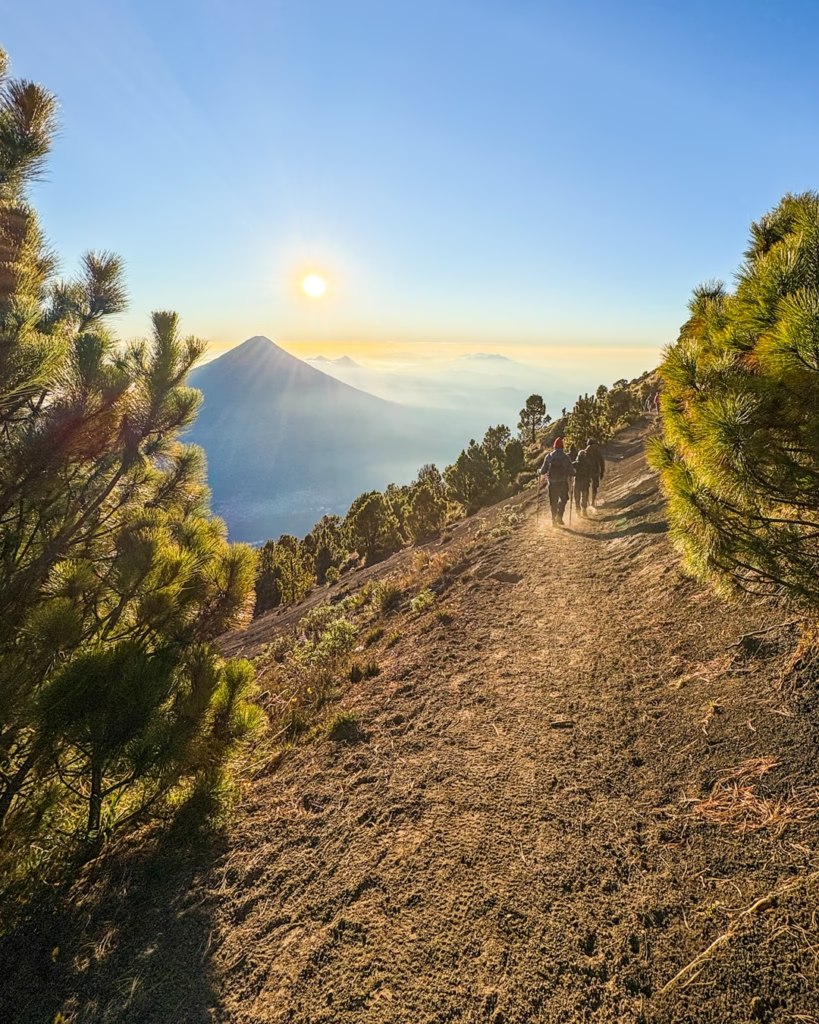
The best example is the Fuego Ridge hike.
After reaching basecamp, you descend into the saddle between Acatenango and Fuego before climbing back towards the viewpoint overlooking the eruptions.
The sunrise summit hike adds even more climbing the following morning.
By the time you’ve completed the full experience, including the Fuego hike and summit push, the actual amount of uphill walking you’ve done is considerably higher than the headline figure suggests.
I don’t have GPS data to calculate the exact cumulative elevation gain, but I wouldn’t be surprised if the true climbing effort ends up closer to 1,800-2,000 metres over the two days.
That’s one reason Acatenango feels significantly harder than the simple elevation statistics imply.

The Mountain Doesn’t Give You Every Metre You Climb
One thing that’s difficult to appreciate from an elevation profile is the terrain itself.
On paper, Acatenango gains roughly 1,554 metres from the trailhead to the summit.
In reality, it rarely feels that efficient.
Large sections of the trail are covered in loose volcanic gravel, ash and dirt.
As the gradient steepens, you’ll often find yourself taking two steps forward and sliding half a step back.
The mountain doesn’t give you every metre you earn.
You can feel yourself working hard, yet look up and realise you’ve made surprisingly little visible progress.
That’s especially noticeable on the steeper upper sections and during the summit push.
It’s one of the reasons I think the actual effort required feels significantly greater than the headline elevation gain suggests.
You’re not just climbing vertically.
You’re constantly fighting the terrain as well.
What The Elevation Gain Actually Feels Like
One thing I underestimated before doing Acatenango was how relentlessly uphill the route feels.
There are very few sections where you genuinely feel like you’re recovering.
The mountain doesn’t hit you with one impossibly steep climb.
Instead, it slowly grinds you down.
The first hour feels manageable.
The second hour feels like a workout.
By the third and fourth hour, you’ve already climbed a significant amount and the mountain starts to wear you down.
Then you look up and realise you’re still not at camp.
The hardest part of the main ascent isn’t necessarily the steepness.
It’s the cumulative effort.
The constant uphill walking gradually drains your legs long before you reach basecamp.

The Biggest Misconception About Acatenango’s Elevation Gain
Most people assume the summit push is where Acatenango becomes difficult.
I don’t think that’s entirely true.
The summit push is certainly hard, but it’s relatively short.
The real challenge is the cumulative effect of spending an entire afternoon climbing before you ever reach camp.
By the time you arrive at basecamp, you’ve already completed most of the mountain’s climbing.
The summit push then adds altitude, lack of sleep, colder temperatures and steeper terrain into the mix.
That’s why the final climb feels so different.
The first day is where you earn the summit.
The second day is where you feel the altitude.
Elevation Gain vs Altitude: What’s The Difference?
A lot of articles accidentally mix these two things together.
They’re related, but they’re not the same.
Elevation gain is how much climbing you do.
Altitude is how high you are.
Acatenango challenges you with both.
The first day is mostly about elevation gain.
You’re climbing continuously for hours while carrying a backpack.
The second day is where the altitude becomes impossible to ignore.
Standing on Acatenango’s summit as the sun came up was probably the moment I understood just how high we actually were.
The summit push isn’t particularly long.
But every step feels more expensive.
You’re operating at nearly 4,000 metres above sea level, running on a few hours of sleep and whatever fuel is left from dinner the night before.
Even simple movements feel harder than they should.
Most people in my group didn’t suffer from altitude sickness.
That doesn’t mean the altitude wasn’t affecting us.
There’s a big difference between suffering from altitude sickness and simply feeling the effects of being nearly 4,000 metres above sea level.

Why The Summit Push Feels Different
The point where I noticed the altitude most wasn’t during the climb to basecamp.
It was during the sunrise summit push.
Ox Expeditions run a crater challenge where hikers can attempt to run around the rim of the crater.
Watching people attempt it was a good reminder of how much altitude changes things.
Near the summit, even a light jog was enough to leave people noticeably out of breath.
At sea level, the same effort wouldn’t feel remotely difficult.
The summit push is relatively short compared to the main climb.
But it often feels disproportionately difficult because you’re combining:
- High altitude
- Steep terrain
- Fatigue from the previous day
- Limited sleep
- Limited fuel
All at the same time.
Most people are absolutely fine at this altitude.
However, when people do start experiencing altitude sickness symptoms, basecamp is often where they first begin to appear.
Even if you don’t suffer from altitude sickness, you’ll almost certainly notice the altitude affecting your performance near the summit.
Acatenango vs Snowdon, Ben Nevis & Scafell Pike
One reason elevation gain can be difficult to visualise is that most people don’t have a reference point.
Here’s how Acatenango compares to some popular UK hikes.
| Hike | Elevation Gain |
|---|---|
| Snowdon (Pyg Track) | ~700m |
| Scafell Pike | ~900m |
| Ben Nevis Mountain Track | ~1,300m |
| Acatenango | ~1,554m+ |
On paper, Acatenango gains more elevation than Ben Nevis.
But the comparison is actually even more dramatic than the numbers suggest.
Ben Nevis starts close to sea level.
Acatenango starts at roughly 2,422 metres above sea level, which is already higher than the summit of every mountain in the UK.
You’re then asked to climb another 1,554 vertical metres on top of that.
Add the altitude, volcanic terrain and overnight backpack and it starts to make sense why so many hikers underestimate it.
Which Is Harder: The Distance Or The Elevation Gain?
Before doing Acatenango, I spent far too much time looking at the distance and not enough time looking at the elevation profile.
That was a mistake.
The full Acatenango hike distance is longer than many websites suggest, but the distance itself isn’t what catches most people out.
The climbing is.
If I had to choose one statistic that best predicts how difficult you’ll find Acatenango, it wouldn’t be the kilometres.
It would be the elevation gain.
Distance tells you how far you’ll walk.
Elevation gain tells you how much work you’ll do.
Can Beginners Handle Acatenango’s Elevation Gain?
Yes.
Most people on the mountain aren’t experienced mountaineers.
Many are backpackers with little or no experience hiking at altitude.
The challenge isn’t technical ability.
It’s endurance.
If you’re reasonably fit, willing to suffer a little and able to keep putting one foot in front of the other, Acatenango is achievable.
If you’re wondering whether you’re physically capable of completing it, I’d recommend reading my guide on how hard the Acatenango hike really is.
My Biggest Mistake
Before doing Acatenango, I thought the distance would tell me everything I needed to know.
It didn’t.
The statistic I should have been paying attention to was the elevation gain.
The distance sounds intimidating.
The climbing is what makes the mountain memorable.
By the time I reached the summit at sunrise, I wasn’t thinking about how many kilometres I’d walked.
I was thinking about how much uphill I’d done to get there.

Acatenango Elevation Gain FAQs
What is the elevation gain on Acatenango?
The net elevation gain from the trailhead to the summit is approximately 1,554 metres.
Is Acatenango harder than Ben Nevis?
In my opinion, yes. Acatenango gains more elevation, reaches a much higher altitude and is usually completed while carrying overnight gear.
Is altitude sickness common on Acatenango?
Most hikers don’t experience serious altitude sickness, but some people begin noticing symptoms around basecamp or shortly after arriving there.
What is harder: the distance or the elevation gain?
For most hikers, the elevation gain is the bigger challenge.
Can beginners do Acatenango?
Yes, provided they have a reasonable level of fitness and are prepared for a demanding two-day hike.