Getting around Nicaragua isn’t quite as straightforward as travelling through some of its Central American neighbours. Unlike Guatemala or Costa Rica, Nicaragua doesn’t have a particularly well-developed backpacker transport network, meaning organised shuttles aren’t always readily available and you’ll occasionally need to work things out for yourself.
That doesn’t mean travelling around Nicaragua is difficult, though. With a little research, some basic Spanish and a willingness to be flexible, getting between the country’s main backpacker destinations is perfectly manageable. In fact, some of the best travel experiences come from figuring things out along the way, whether that’s jumping on a local chicken bus, sharing a taxi with fellow travellers or discovering an alternative route you hadn’t considered.
Having travelled through León, Granada, Ometepe and Popoyo, I’ve put together this guide to getting around Nicaragua, covering the different transport options, what to expect and some practical advice to make your journey a little easier.
Quick Facts: Getting Around Nicaragua
| Chicken buses | Cheapest way to travel, but limited timetables and comfort |
| Tourist shuttles | Convenient but less widely available than in Guatemala or Costa Rica |
| Taxis | Affordable, particularly when sharing with other travellers |
| Ferries | Main way to reach Ometepe Island |
| Booking platforms | Bookaway and 12Go have relatively limited coverage |
| Payments | Cash is essential for most local transport |
| Language | Basic Spanish is extremely useful |
Contents
1. Chicken Buses in Nicaragua
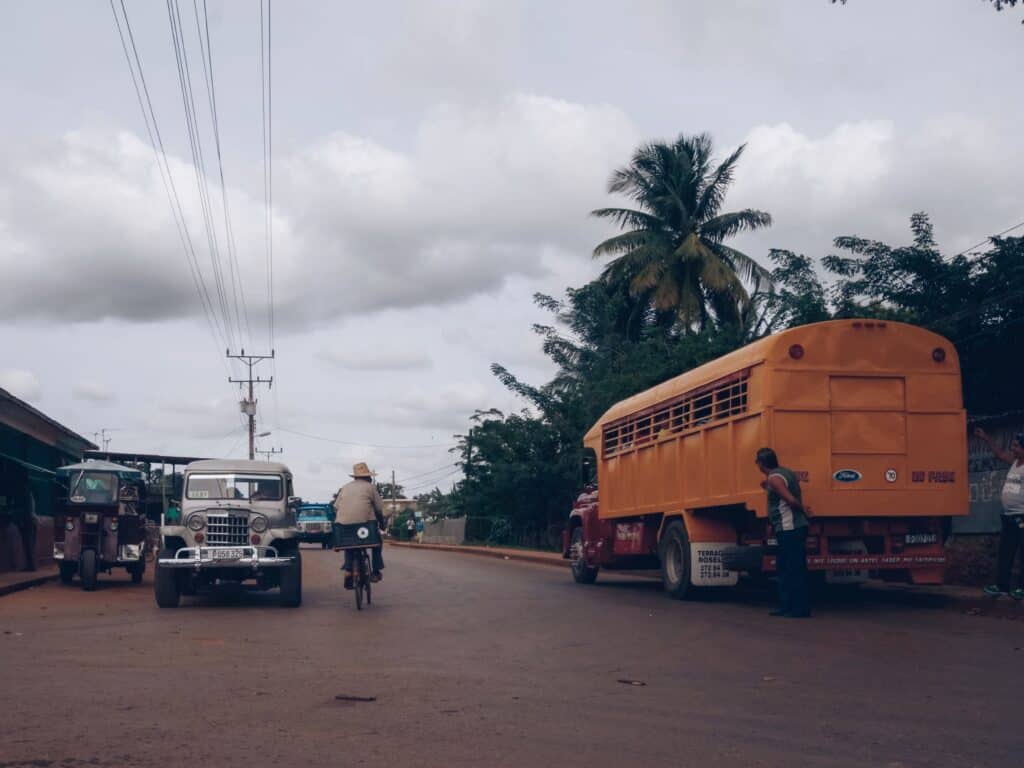
Chicken buses are the traditional local buses you’ll find throughout Central America, and Nicaragua is no different. Usually converted from old American school buses, they’re a cheap and widely used way for locals to get around.
They’re not particularly comfortable, don’t necessarily operate to a reliable timetable and can get pretty busy, but they get the job done. If you’re travelling on a backpacker budget, they’re generally the cheapest way to cover longer distances.
I only used chicken buses for part of my journey towards Ometepe. Having met another traveller at Oasis Hostel who knew which route to take, I tagged along with them, and we ended up travelling as a group of four.
One thing worth mentioning is that chicken buses aren’t really a journey where you can put your headphones in, fall asleep and forget about the world. With locals frequently getting on and off, it’s worth staying a little more switched on, keeping an eye on your belongings and paying attention to your surroundings.
My advice? One earbud in, one out, and keep your bag somewhere you can see it.
Are Chicken Buses Safe in Nicaragua?
Chicken buses are a normal part of everyday life in Nicaragua and are used extensively by locals. There’s no particular reason to avoid them, but the usual precautions apply.
Keep your valuables secure, avoid leaving your phone or wallet easily accessible and stay aware of your belongings when passengers are getting on and off.
If you’re travelling with a large backpack, keep an eye on where it’s stored rather than assuming it will be looked after.
2. Travelling by Taxi in Nicaragua
Taxis are a particularly useful transport option in Nicaragua, especially if you’re travelling with other backpackers.
I found them relatively affordable compared with some other Central American countries, and the fact that most of Nicaragua’s main backpacker destinations are concentrated around the western side of the country means journey distances are often fairly manageable.
Sharing a taxi between two, three or four people can make what initially seems like an expensive option surprisingly reasonable.
Shared Taxis Between Destinations
One of my journeys was from Ometepe to Popoyo. Originally, I had planned to use chicken buses for the journey, but while socialising at Raindance on Ometepe, I met another traveller heading in the same direction.
He was on a shorter trip and had already arranged a private taxi for himself. Having asked whether I could join him, he was more than happy to share.
We took his quad bike back to the port, caught the ferry across to the mainland and met the taxi on the other side. From there, we travelled directly to our hostel in Popoyo, approximately 50km away.
I chipped in some money towards the journey as a thank you, and what could have been a fairly complicated journey using public transport turned into a straightforward door-to-door trip.
It’s a good example of why making friends and being open to sharing transport can make backpacking Nicaragua considerably easier.
Getting from Popoyo to Costa Rica
Another example came at the end of my time in Nicaragua, when a group of four of us were travelling from Popoyo towards Costa Rica.
Our original plan was to take a taxi from Popoyo to the nearest chicken bus stop, as public buses don’t run directly to Popoyo. From there, we would continue towards the border using local transport.
However, while speaking with our taxi driver, we asked how much he would charge to take all four of us directly to the border. The price was reasonable enough when split between us, so we decided to save ourselves the additional connections and go with him all the way.
We crossed the border independently and continued into Costa Rica by bus.
My advice: Don’t automatically rule out private taxis because you assume they’ll be too expensive. Ask drivers how much they would charge for the full journey and see what the price looks like when split between a group.
3. Tourist Shuttles in Nicaragua
If you’ve travelled through Guatemala or Costa Rica, you’ll probably be familiar with the backpacker shuttle system. In these countries, it’s relatively easy to organise transport between popular destinations, with plenty of companies offering shared journeys.
Nicaragua isn’t quite at that stage yet.
There are tourist shuttles available, but the network is less developed and you shouldn’t assume there will be a convenient service for every journey.
My Experience: León to Granada
I booked my shuttle from León to Granada through Bigfoot Hostel, arranging everything just one day before travelling.
The journey was a straightforward door-to-door service, making it a convenient way to cover the approximately 134km between the two cities. Bigfoot lists its shared shuttle at around US$19.90 per person.
Of course, taking a chicken bus would be considerably cheaper, but I thought the extra cost was worthwhile for the convenience and lack of hassle.
It also depends on how long you’re travelling for. I met plenty of backpackers on six-month trips or longer, for whom those additional transport costs would quickly add up. For them, taking local buses wherever possible made considerably more financial sense.
For someone travelling for a shorter period, however, I’d be more inclined to spend a little extra to save time and make travel days easier.
Should You Book Shuttles in Advance?
Not necessarily. My experience was that some journeys could be arranged relatively easily through hostels, even just a day beforehand.
However, availability is more limited than in neighbouring countries, so I’d avoid leaving everything until the last minute if you have a particularly important connection to make.
It’s also worth noting that platforms such as Bookaway and 12Go aren’t particularly useful for Nicaragua yet. I’d recommend asking your accommodation about available transport rather than relying entirely on online booking platforms.
4. Getting to the Treehouse Party
One slightly unusual exception to Nicaragua’s limited shuttle network is the transport available for the famous Treehouse Party near Granada.
Despite being relatively isolated, the Treehouse has a surprisingly organised transport system, with options available from different locations.
You can book your ticket directly through the Treehouse website, where you’ll also find transport options depending on where you’re travelling from.
When I visited, I arranged the shuttle from Granada, which was very straightforward. Pickups were easy to organise, and the return journey was included, dropping everyone back at Hostel de Boca en Boca.
There were also transport options advertised from Popoyo, which I found particularly surprising given how limited the wider shuttle network is.
It’s worth checking the official website when booking, as departure locations and availability can change.
If you’re attending the party, I’d recommend using the organised transport rather than trying to arrange your own journey. Given the location, having your return journey sorted in advance makes the whole experience considerably easier.
5. Getting the Ferry to Ometepe
Ometepe Island is one of Nicaragua’s most popular backpacker destinations, and reaching it involves taking a ferry across Lake Nicaragua.
The main ferry crossing for travellers heading to the island is between San Jorge on the mainland and Moyogalpa on Ometepe. The process is relatively straightforward, although getting to the ferry terminal can require a combination of local buses and taxis depending on where you’re travelling from.
Getting to the Ferry Terminal
When travelling from Granada, we caught a chicken bus from a stop within walking distance of our hostel.
Our initial research suggested we’d need to change buses or potentially take a taxi for part of the journey. However, when we arrived at the bus stop, we discovered an alternative service that went directly to the ferry terminal for a very small additional cost.
I believe this was around 50 Nicaraguan córdobas, although I can’t confirm the exact amount. It was a small additional expense that saved us the hassle of arranging another connection.
The bus dropped us directly at the ferry terminal, where we paid two separate charges: one for the applicable tax and another for the ferry itself.
Buying Ferry Tickets
Buying tickets was very easy. The ticketing area was relatively obvious, and if you’re unsure where to go, the staff are happy to point you in the right direction.
Ferries operate throughout the day, with regular departures. The crossing itself is an interesting experience. When it’s windy, the water can look surprisingly choppy, which might make you question what you’ve signed up for. However, despite how rough it looks from the shore, I found the crossing perfectly comfortable.
There were no issues taking our backpacks aboard either.
Once you arrive on the other side, you’ll encounter the usual collection of taxi drivers waiting for passengers coming off the ferry. We joined a shared taxi and went directly to our accommodation.
My advice: Don’t worry too much about organising the ferry in advance. Turn up, buy your ticket and allow a little flexibility around departure times.

6. Practical Tips for Getting Around Nicaragua
There isn’t necessarily one perfect way to organise transport in Nicaragua. My journeys involved a mixture of hostel shuttles, chicken buses, ferries and shared taxis, with each one arranged slightly differently.
However, there are a few things I’d recommend keeping in mind.
Make Friends Along the Way
This is probably my biggest piece of advice, particularly if you’re a relatively laid-back traveller who doesn’t always plan every journey days in advance.
If you make enough friends along the way, there’s a good chance someone will be heading to the same destination as you on the same day and will already know what they’re doing.
My journey from Ometepe to Popoyo is a perfect example. Rather than navigating several chicken buses independently, I ended up sharing a taxi with someone I’d met while socialising.
Obviously, this isn’t always going to be possible, and you still need to be comfortable finding your own solutions when it isn’t. But travelling socially can make a real difference in a country where the backpacker transport network isn’t particularly developed.
Carry Cash
Cash is essential for getting around Nicaragua.
For the journeys I took, I paid in cash, whether that was chicken buses, ferry tickets or taxis. Don’t assume you’ll be able to pay by card, particularly when using local transport.
It’s worth keeping smaller denominations available too, rather than relying on drivers or bus operators to have change for larger notes.
Learn Some Basic Spanish
You don’t need to be fluent in Spanish to travel around Nicaragua, but having a basic understanding will make things considerably easier.
Even knowing how to ask how much something costs, where a bus is going or whether a driver is heading to a particular destination will help.
Unlike travelling on organised tourist shuttles, where English-speaking staff are more common, you’ll often be dealing directly with local drivers and bus operators.
A little Spanish goes a long way.
Be Flexible With Your Plans
Don’t expect every journey to work exactly as you’ve planned it.
Transport options aren’t always particularly well documented online, and you might find that something you expected to be complicated turns out to be surprisingly easy once you arrive.
Ask hostel staff, speak to other travellers and don’t be afraid to ask local drivers about alternative options.
Just make sure you leave yourself enough time on travel days, particularly when you have a ferry, border crossing or onward connection to make.
7. Is Nicaragua Easy to Travel Around?
Compared with other Central American countries, I’d put Nicaragua towards the more challenging end of the scale when it comes to independent transport.
It doesn’t have the same established backpacker shuttle network as Guatemala or Costa Rica, and you’ll occasionally need to put a little more thought into working out how to get from one destination to another.
However, I wouldn’t describe it as difficult.
Chicken buses are cheap, taxis are relatively affordable, the ferry system is straightforward and there are enough other backpackers travelling the same routes to make sharing transport a realistic option.
If you have a little intuition, some basic Spanish and the ability to think for yourself, travelling independently around Nicaragua is perfectly manageable.
In fact, I’d argue that having to figure things out as you go is part of what makes travelling here enjoyable. Just don’t expect every journey to be as simple as booking a shuttle, putting your headphones in and switching off.
Frequently Asked Questions
What is the best way to get around Nicaragua?
There isn’t one single best option. Chicken buses are the cheapest way to travel, while taxis and tourist shuttles offer more convenience. I’d recommend combining different transport methods depending on your route, budget and how much time you have.
Are chicken buses safe in Nicaragua?
Chicken buses are widely used by locals and are a normal part of everyday transport. Keep your belongings secure, stay aware of your surroundings and avoid leaving valuables unattended.
Are there tourist shuttles in Nicaragua?
Yes, although the network is less developed than in countries such as Guatemala and Costa Rica. Some hostels arrange shared shuttles, but you shouldn’t assume they’re available for every route.
Can you travel around Nicaragua without speaking Spanish?
It’s possible, but basic Spanish will make things considerably easier. Knowing how to ask about prices, destinations and departure points is particularly useful when using local transport.
Do you need to book transport in Nicaragua in advance?
Not always. Some journeys can be organised through hostels just a day beforehand, while local buses and ferries can generally be arranged on arrival. I’d recommend planning ahead when you have an important onward connection.
How do you get to Ometepe Island?
You need to take a ferry across Lake Nicaragua, usually from San Jorge to Moyogalpa. You can reach the ferry terminal using local buses or taxis, purchase your ticket at the terminal and take the ferry across to the island.
Is it easy to get from Nicaragua to Costa Rica?
Yes. You can travel towards the border using a combination of taxis and local buses, then continue into Costa Rica using onward transport. From Popoyo, you’ll need to arrange transport to the border as there isn’t a direct chicken bus service.
Planning the rest of your trip? Read my Nicaragua Travel Guide for an overview of the country, or use my Nicaragua itinerary to plan your route.
You can also read my guides to Nicaragua travel costs, where to stay in Nicaragua and whether Nicaragua is safe to visit before setting off.