León is one of Nicaragua’s most popular backpacker destinations, and for good reason. While the city itself might not be the prettiest you’ll encounter in Central America, it offers something that few other destinations can compete with: the opportunity to slide down the side of an active volcano at speeds of up to 80km/h.
Volcano boarding at Cerro Negro is the main reason most backpackers make their way to León, and it’s an experience that more than lives up to the hype. Add in a lively backpacker scene, affordable food, colonial architecture and some memorable hostel parties, and there’s enough here to justify a couple of nights on your Nicaragua itinerary.
I spent two nights in León, staying at Bigfoot Hostel and taking their sunset volcano boarding tour. It ended up being one of the best days of my entire trip through Central America, although perhaps not entirely for the reasons I expected.
Here’s everything you need to know about visiting León, including the best things to do, where to stay and why you shouldn’t leave without trying volcano boarding.
León at a Glance
- Best known for: Volcano boarding at Cerro Negro
- Recommended stay: 2–3 nights
- Best experience: Bigfoot’s sunset volcano boarding tour
- Best area to stay: Around the central backpacker hostels
- Budget: Affordable, particularly for food and hostels
- Getting around: Mostly on foot within the city
- Best for: Backpackers, adventure seekers and social travellers
1. Things to Do in León
León isn’t a destination with an endless list of attractions. Compared with somewhere like Antigua in Guatemala, its colonial streets are a little rougher around the edges, and the city doesn’t have quite the same picturesque feel.
That said, there’s a reason it features so heavily on Nicaragua’s backpacker route. Most people come for volcano boarding, and the city has built much of its backpacker culture around that experience.
Here are the main things worth making time for.
Volcano Boarding at Cerro Negro
If there’s one thing you absolutely cannot miss in León, it’s volcano boarding at Cerro Negro.
Located just outside the city, Cerro Negro is an active volcano covered in loose black volcanic ash. Rather than simply hiking to the summit and enjoying the views, visitors can put on an orange jumpsuit, climb onto a specially designed board and slide down the side of the volcano.
It’s an unusual experience, to say the least, and easily the highlight of my time in León.
I’ll cover the entire experience in more detail below, but if you’re visiting León for just one reason, make it this.
Visit León Cathedral
León Cathedral, officially the Cathedral Basilica of the Assumption of the Blessed Virgin Mary, is one of the city’s most recognisable landmarks.
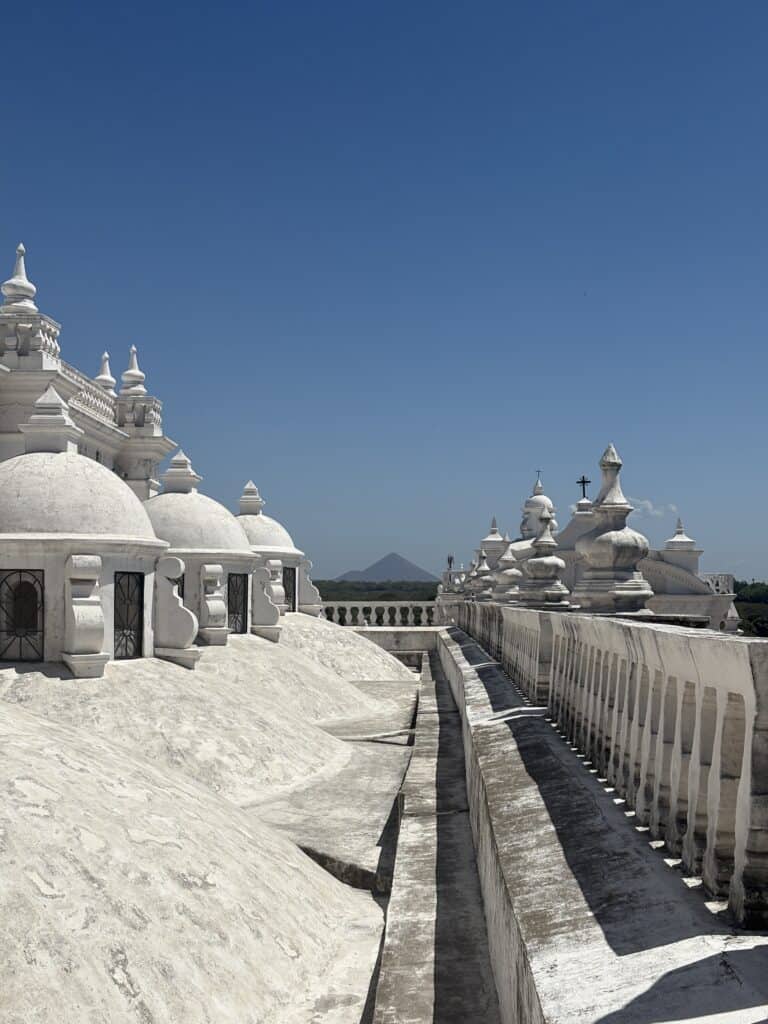
The white cathedral dominates the central square and is worth a visit while exploring the city. You can head inside to appreciate the architecture and then make your way up to the rooftop.
The rooftop is particularly nice, with its distinctive white domes and views across the surrounding city. It’s not an enormous skyline, so don’t expect panoramic city views on the scale of some larger destinations, but it’s a pleasant place to spend a little time.
Having seen some of Europe’s most impressive cathedrals, particularly in Italy, I perhaps wasn’t as easily impressed as I could have been. Nevertheless, it’s worth adding to your itinerary, especially given how little effort it takes to visit.
Explore the Local Markets
A short walk from the cathedral, you’ll find León’s local markets.
They’re nothing particularly spectacular, but they’re useful if you’re travelling on a budget and want something cheap to eat. You’ll find the usual selection of local food, fresh produce and everyday essentials, with plenty of inexpensive options.
I picked up some food here during my stay, and it’s a good place to experience a little more of everyday life in León away from the backpacker hostels.
Visit Surfing Turtle Lodge for the Beach Olympics
One thing I wish I’d known about before leaving León was the Beach Olympics at Surfing Turtle Lodge.
Located on Isla Los Brasiles, near Poneloya, Surfing Turtle Lodge is a beachfront hostel that offers a different kind of backpacker experience away from the city.
I didn’t make it there myself, but I met another traveller who showed me some footage of their Beach Olympics day. Think traditional school sports day, with teams competing in various races and games on the beach, naturally accompanied by a healthy amount of alcohol. I even remember seeing a race on a makeshift slip-and-slide, using a large tarpaulin, which looked particularly hilarious.
It reminded me of NESTival, a well-known hostel event in Cambodia with a similarly chaotic, sociable atmosphere. It’s exactly the sort of ridiculous day that makes backpacking so much fun.
If you have some spare time in León and fancy getting out of the city, it’s something I’d look into. I genuinely wish I’d made the time to go.
2. Volcano Boarding at Cerro Negro
Volcano boarding is the defining experience of León, and Bigfoot Hostel is one of the biggest operators offering tours to Cerro Negro.
I went with Bigfoot’s sunset tour, and I honestly couldn’t recommend it enough. Not only was the volcano boarding itself brilliant, but the entire day turned into one of the best social experiences of my trip.
Booking Your Volcano Boarding Tour
Bigfoot Hostel runs volcano boarding tours every day, and it’s such a central part of the hostel’s schedule that it effectively becomes the main activity of the day.
I booked directly through Bigfoot, and everything was organised extremely well. They’re one of the biggest operators in León, and I have nothing but positive things to say about the experience.
There are different tour options, but I’d strongly recommend choosing the sunset departure if available. It gives you the chance to watch the sun go down over the volcanic landscape before enjoying what is arguably the best part of the entire day: the journey back to the hostel.
Bigfoot’s sunset tour was advertised at $37.90, plus a $10 volcano entrance fee at the time of checking. Prices can change, so check directly with the operator for the latest pricing and availability.
The Journey to Cerro Negro
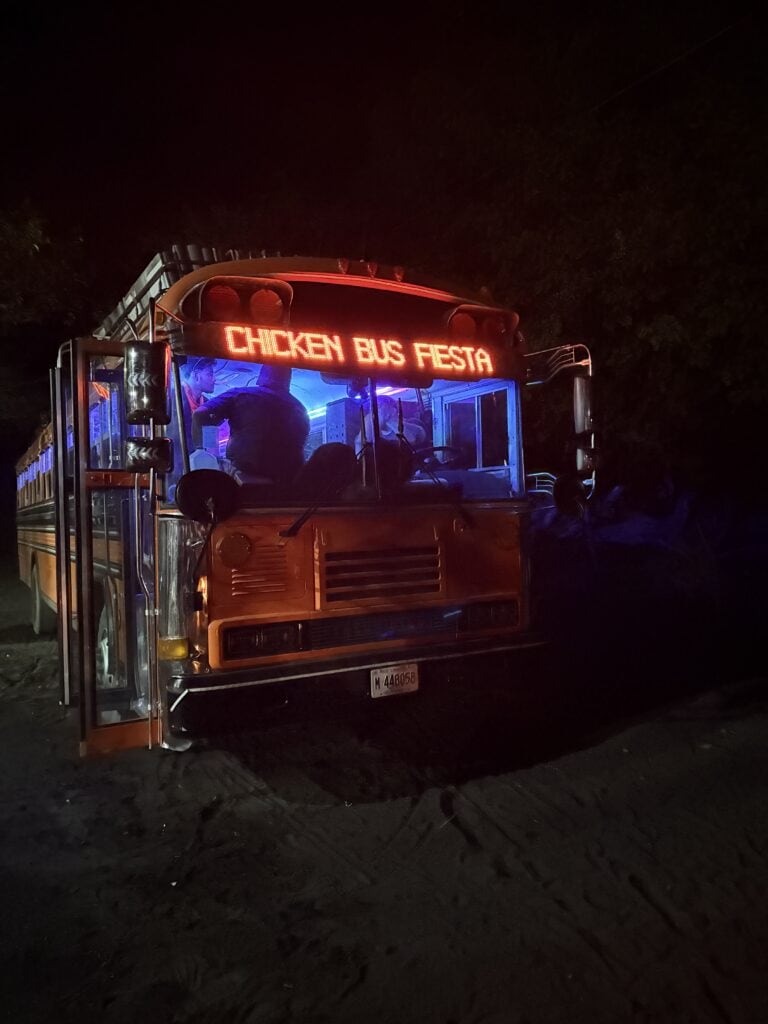
The tour starts at Bigfoot Hostel, where everyone climbs aboard a rather unusual-looking chicken bus.
Unlike your typical Nicaraguan chicken bus, this one has been modified for the occasion. There’s a large bench-style seat running around the perimeter of the bus, with several metal poles running through the middle for passengers to hold onto.
On the way there, it’s not immediately obvious why those poles are necessary. Everyone is sitting around the sides, the atmosphere is fairly subdued and most people are still getting to know one another.
It’s a reasonably long journey, and there’s a noticeable sense of anticipation as you get closer to the volcano.
You’ll eventually arrive at Cerro Negro, where there’s a short briefing and a waiver to sign before starting the hike.
Hiking to the Summit
The hike up Cerro Negro takes roughly a couple of hours, depending on the group and conditions.
One thing worth knowing beforehand is that you have to carry your own volcano boarding board up the mountain. They’re not particularly convenient to carry, especially alongside everything else you’re taking, although you can pay a porter to take yours up for you if you’d rather save yourself the effort.
It’s not an especially long hike, but the loose volcanic terrain and exposed landscape make it a little different from your usual mountain walk.
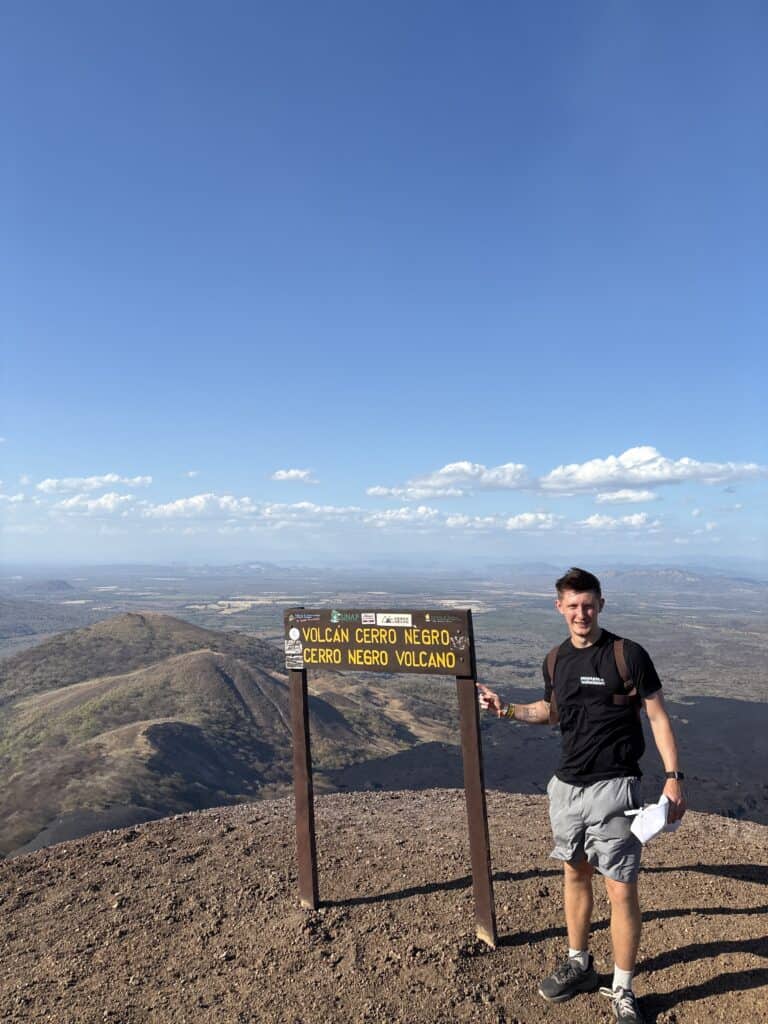
One of the first things you’ll notice when reaching the summit is the view. Cerro Negro is a relatively isolated peak, meaning you can see for miles across the surrounding volcanic landscape.
It’s an incredible setting, although there’s one thing you should prepare yourself for: the wind.
It’s incredibly exposed at the top, and the wind can be surprisingly strong. There’s also a fascinating little feature near the summit where a small hole has been dug into the volcano. Put your hand inside and you can feel the heat radiating out from beneath the surface, a reminder that you’re standing on an active volcano.
Once everyone has had time to take in the views, it’s time to get into the famous orange jumpsuits.
How Does Volcano Boarding Work?
Before anyone sets off, the guides explain exactly how to use the board and control your speed.
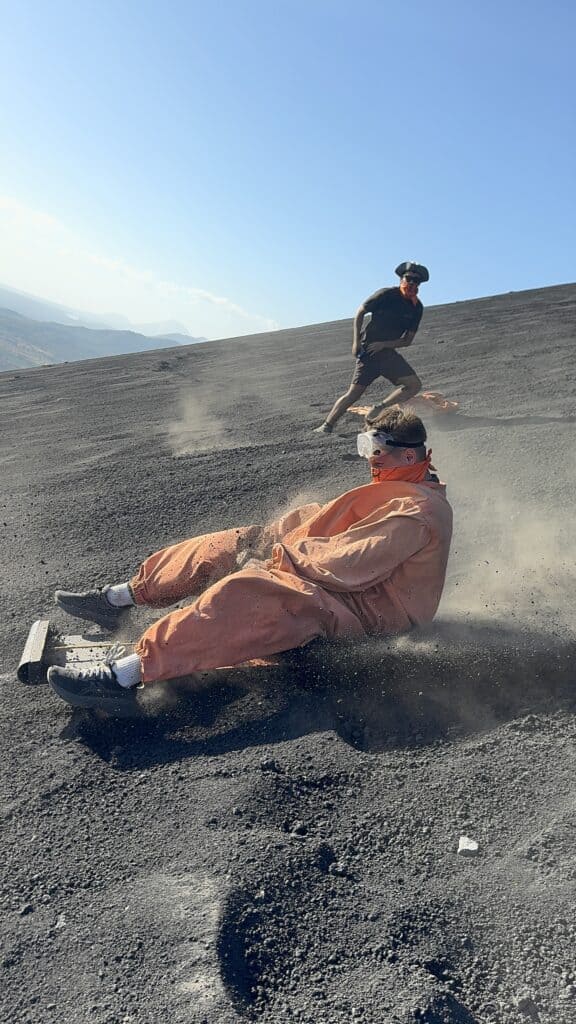
The technique is relatively straightforward. You sit on the board, hold onto the handle and use your feet to control how quickly you descend. The seat itself is little more than a small wooden lip at the back of the board, so it’s not exactly the most comfortable ride you’ll ever have!
Pulling hard on the handle lifts the front of the board slightly off the ground, reducing drag and allowing you to pick up more speed. You can then use your feet as brakes, digging them into the loose volcanic ash to slow down.
You can also shift your weight to steer from side to side, following the smoother tracks that have been created down the volcano.
Everyone is given the same basic instructions, but how you approach the descent is entirely up to you. Some people are determined to go as fast as possible, while others spend most of their descent applying the brakes.
Our guide mentioned that he’d seen people take more than half an hour to reach the bottom, while others managed to do it in just a few seconds.
The guides also use a speed gun to record everyone’s top speed, so there’s a little competition within the group. There’s even a prize for whoever manages the fastest descent, which I believe was shots back at the hostel.
There’s no pressure to go fast, and you can take it at whatever pace you’re comfortable with.
The Descent: My Experience
Standing at the top and looking down, it’s surprisingly intimidating.
Everyone in our group was nervous, particularly because the initial section isn’t especially steep. You can see the first few people setting off, but as they reach the steeper section, they quickly disappear from view.
It’s almost like a short warm-up before the volcano really starts to drop away beneath you.
I ended up being one of the first to go down, although that wasn’t particularly intentional!
In hindsight, I’d actually recommend being towards the front of the group if you can. Once you reach the bottom, you get a brilliant view of everyone else making their way down the mountain, which is almost as entertaining as the descent itself.
My approach was simple: go as fast as possible.
Unfortunately, I wasn’t particularly good at staying within the smoother tracks that had been created down the volcano. These tracks help reduce drag and make it easier to control your direction, but I managed to drift quite considerably outside of them.
I still managed to reach around 60km/h, while the fastest people in our group hit approximately 80km/h.
I made it around 80% of the way down without any major problems, but then things started to go wrong.
I slipped forwards off the small wooden lip at the back of the board, shifting my weight too far forward to properly lift the front of it. The board started collecting loose gravel, became increasingly difficult to control and eventually I went tumbling down the volcano.
It’s not particularly painful, even when you’re travelling at speed, although you’re likely to pick up a few minor scrapes and bruises.
I also managed to make a fairly basic mistake before setting off: forgetting to put my goggles on.
There are some rather comical photographs of me halfway down the volcano with my eyes practically closed as volcanic ash and gravel are being fired directly into my face.
A lesson learned!
The guides explain what to do if you come off the board, and several people in our group did so without suffering any significant injuries. Just listen carefully to the briefing, wear the protective equipment provided and don’t feel pressured to chase the fastest speeds.
Sunset, Watermelon and a Well-Deserved Cider
Once everyone has made it to the bottom, the group gathers back together before climbing onto the roof of the bus.
This is where the sunset tour really comes into its own.
You sit on top of the bus, looking out across the enormous black ash fields as the sun starts to disappear over the horizon. There’s watermelon being passed around, a few well-deserved ciders and plenty of conversation about everyone’s attempts at the descent.
After the adrenaline of the volcano boarding, it’s a brilliant way to wind down and enjoy the surroundings.
But the day isn’t over yet.
The Best Party Bus in Central America?
If the journey to Cerro Negro is relatively subdued, the journey back to Bigfoot is quite the opposite.
The guides turn the music up, start passing around bottles of alcohol and begin spraying drinks directly into people’s mouths as the bus bounces its way back towards León.
There are people dancing, backflips off the metal bars, upside-down shots and pretty much everything in between.
The music is blaring, everyone is in high spirits and the entire bus turns into one enormous travelling party.
It’s difficult to explain just how ridiculous the atmosphere becomes, but it’s genuinely one of the most entertaining experiences I’ve had while travelling.
Think a bus full of backpackers, questionable dancing, white-girl bangers and absolutely no concern for what anyone else thinks.
By the time you get back to Bigfoot, the party continues at the hostel, making the entire experience feel like one enormous organised social event.
It’s an incredibly effective way of bringing a group of strangers together, and one of the reasons I’d recommend Bigfoot’s sunset tour so strongly.
If you’re going to do volcano boarding in León, don’t just book any tour. Make sure you experience the sunset trip and the journey back.
3. Where to Stay in León
Bigfoot Hostel
If you’re visiting León primarily for volcano boarding, Bigfoot Hostel is an obvious choice.
It’s one of the biggest backpacker hostels in the city and is particularly well known for its daily volcano boarding excursions.
I stayed here for my two nights in León and found it did the basics very well. The beds were comfortable, the toilets and showers were good, and there were facilities such as a pool table to keep you occupied.
It’s not necessarily the most impressive hostel I’ve stayed in, particularly in terms of its atmosphere during the day. However, the daily activities make it an extremely social place once everyone starts getting involved.
The volcano boarding trip is effectively the centrepiece of the hostel’s schedule, with the group returning together for the evening party.
If you’re looking for a social hostel where you can meet other travellers and experience one of Nicaragua’s most popular activities, Bigfoot is a solid option.
For more accommodation recommendations across the country, see my guide to where to stay in Nicaragua.
4. Food and Drink in León
León is an affordable place to eat, and you don’t need to spend much to find something decent.
I didn’t discover any particular restaurants that stood out during my stay, instead relying on the local markets for inexpensive food.
One place I do remember enjoying was a burrito truck on the street after the volcano boarding trip. After a long day of hiking, sliding down a volcano and drinking on the journey back, it was exactly what I needed.
If you’re travelling on a budget, I’d recommend making use of the local markets and street food rather than looking for expensive restaurants.
The backpacker hostels also provide plenty of opportunities to socialise over drinks, particularly after the daily volcano boarding trips.
5. Getting Around León
One of the nice things about León is that you don’t need to worry too much about transport once you’re in the city.
The main attractions, including León Cathedral, the central square and local markets, are all within walking distance of one another.
I walked everywhere during my stay and never felt the need to arrange taxis or other transport.
For excursions outside the city, such as volcano boarding at Cerro Negro, transport is generally organised by the tour operator.
If you’re planning to visit Surfing Turtle Lodge or the nearby beaches, you’ll need to arrange separate transport.
For more information about travelling between destinations in Nicaragua, see my guide to getting around Nicaragua.
6. How Long to Spend in León
I’d recommend spending 2–3 nights in León.
The city itself doesn’t have a huge number of attractions, and most backpackers will find that volcano boarding is the main reason to visit.
Two nights is enough to explore the city, recover from a long journey and experience the sunset volcano boarding tour, including the evening party.
If you’re arriving after a particularly long border crossing or want to visit Surfing Turtle Lodge and the surrounding beaches, three nights gives you a little more flexibility.
Personally, I spent two nights here and felt that was enough to experience the highlights.
My advice would be to arrive, take some time to recover, enjoy the city and then dedicate your main full day to volcano boarding.
If you’re planning your wider route, my Nicaragua itinerary explains how León fits into a backpacking trip around the country.
7. Is León Worth Visiting?
Absolutely.
León might not have the picturesque colonial streets of Antigua or the same range of attractions as some of Central America’s larger destinations, but it doesn’t need to.
The main attraction is one of the most unique experiences you can have while travelling through Nicaragua, and it’s worth making the journey for that alone.
Volcano boarding at Cerro Negro is an incredible day out, particularly if you choose Bigfoot’s sunset tour. The combination of hiking an active volcano, racing down its slopes, watching the sunset over the ash fields and finishing with one of the most entertaining party bus journeys imaginable makes it an experience that’s difficult to forget.
For backpackers looking for a mixture of adventure, socialising and affordable travel, León is an easy recommendation.
I’d give it two nights, make sure you book the sunset volcano boarding tour and then continue exploring the rest of Nicaragua.
For an overview of the country and its other destinations, head over to my Nicaragua Travel Guide.
8. Frequently Asked Questions About León
Is León worth visiting in Nicaragua?
Yes. León is one of the best stops on a Nicaragua backpacking itinerary, primarily because of volcano boarding at Cerro Negro. The city itself has some interesting colonial architecture, markets and a lively backpacker scene, but the volcano boarding experience is the main reason to visit.
How many days do you need in León?
Two to three nights is generally enough. Two nights gives you time to explore the city and experience volcano boarding, while three nights allows you to visit nearby beaches or Surfing Turtle Lodge.
Can you go volcano boarding in León?
Yes. Cerro Negro, located just outside León, is one of the world’s best-known volcano boarding destinations. Several operators run organised excursions, including Bigfoot Hostel, which offers daily trips.
How much does volcano boarding cost?
Bigfoot advertised its sunset volcano boarding tour at $37.90, with an additional $10 volcano entrance fee at the time of checking. Prices can change, so check directly with the operator before booking.
Is volcano boarding dangerous?
There are some risks involved, as you’re descending a volcanic slope at potentially high speeds. You can fall off the board and pick up minor cuts and bruises, particularly if you lose control. Operators provide protective equipment and explain how to control your speed and what to do if you fall. Listen to the briefing and go at a pace you’re comfortable with.
Is León safe for tourists?
I felt comfortable enough exploring León during my stay, although, as with anywhere, it’s sensible to take normal precautions, particularly at night. For a more detailed breakdown of safety across the country, read my guide to Is Nicaragua Safe?
Where should you stay in León?
Bigfoot Hostel is a popular choice for backpackers, particularly those wanting to experience volcano boarding. It has comfortable facilities, organised daily activities and a very social atmosphere during the evening excursions. For more recommendations, see my Nicaragua accommodation guide.
What is León famous for?
León is best known among backpackers for volcano boarding at Cerro Negro. It’s also an important historic city, with colonial architecture, León Cathedral and a strong cultural identity.
Final verdict: León might not be the prettiest city in Nicaragua, but it offers one of the country’s most memorable backpacking experiences. Don’t skip it.